
 +91-9210-914-391
 WhatsApp

 Book Appointment
Exotropia: Causes, Symptoms & Treatment Options
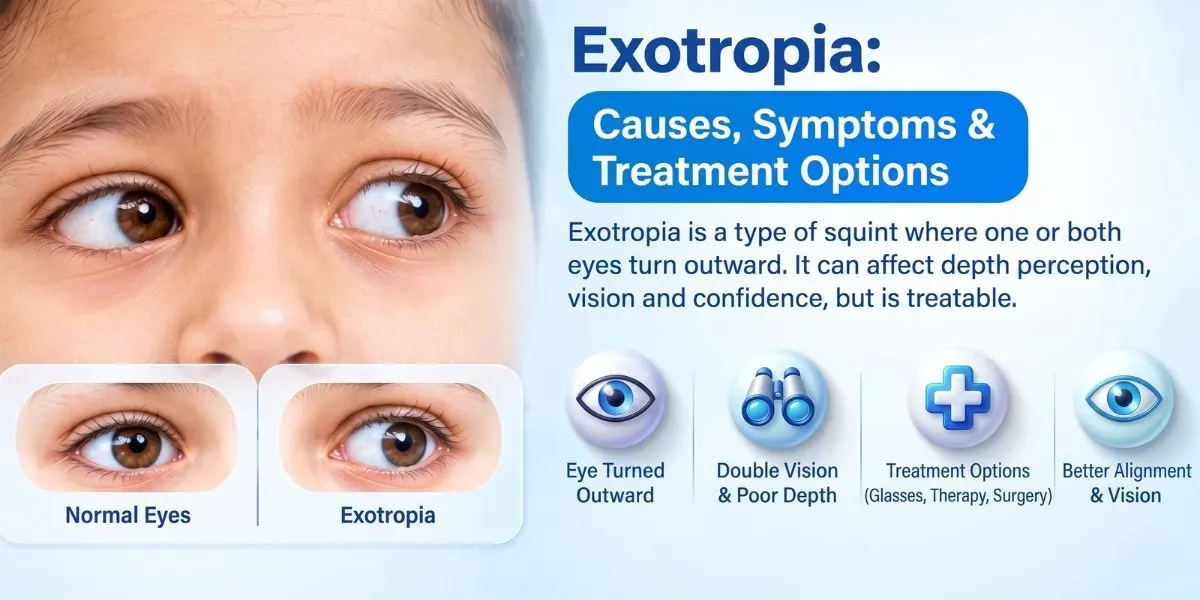
Exotropia is when one or both eyes drift outward instead of looking straight ahead — most common in young children, but it affects adults too. Here's what causes it, how it's diagnosed, and whether glasses, eye exercises or surgery is the right path.

Quick Answer
Exotropia is a type of strabismus (squint) where one or both eyes turn outward instead of looking straight ahead, either constantly or intermittently. It's most often first noticed in children aged 1-4, but can occur or persist into adulthood. Causes include uncorrected farsightedness, muscle imbalance, neurological conditions, or vision loss in one eye. Many mild, intermittent cases are managed with glasses or vision therapy; larger or constant exotropia often needs eye muscle surgery for lasting correction.
Key Takeaways
- Exotropia means the eye turns outward — the opposite of esotropia, where it turns inward.
- Intermittent exotropia (comes and goes) is more common than constant exotropia.
- Treatment ranges from glasses and vision therapy to eye muscle surgery, based on severity.
- Untreated exotropia can progress from intermittent to constant, and risks amblyopia and lost depth perception.
- Sensory exotropia can develop in adults whose vision loss in one eye causes that eye to drift.
- Regular squint check-ups in children help catch and manage exotropia before it worsens.
Normal Alignment vs Exotropia
What Is Exotropia?
Exotropia is a type of strabismus in which one or both eyes turn outward, away from the nose, rather than looking straight ahead. It can be constant (always present) or intermittent (only occurring under specific conditions, such as fatigue, illness, or daydreaming). Intermittent exotropia is more common than the constant form, and early signs are often first noticed in children between 1 and 4 years of age. Left unaddressed, exotropia can progress from occasional drifting to a constant misalignment.
Exotropia vs Esotropia: What's the Difference?
Exotropia: the eye turns outward, away from the nose. Esotropia: the eye turns inward, toward the nose — the opposite direction. Both are forms of strabismus (squint), affect children and adults, and are diagnosed and treated with similar methods (glasses, vision therapy, surgery) — but the direction of drift and some underlying causes differ, which is why an accurate diagnosis matters for choosing the right treatment.
Signs of Exotropia
Children may not complain of visual difficulty even when it's present — regular squint screening by an eye specialist is advised whenever outward eye turning is noticed, since kids often can't describe what's wrong.
What Causes Exotropia?
Muscle Imbalance
Imbalance in the extraocular muscles controlling eye movement is one of the most common underlying mechanisms.
Uncorrected Refractive Errors
Particularly uncorrected farsightedness, which forces extra focusing effort that can disrupt eye alignment.
Neurological Conditions
Conditions like cerebral palsy or Down syndrome are linked to higher rates of exotropia.
Family History
A family history of strabismus raises the likelihood of a child developing exotropia.
Premature Birth / Low Birth Weight
Both are recognised risk factors for developing strabismus in early childhood.
Sensory Exotropia: A Different Pattern in Adults
Sensory exotropia develops when one eye has significantly poorer vision than the other — often from an untreated refractive error, cataract, or eye disease — causing the weaker eye to drift outward as the brain stops using it for binocular vision. It can affect both children and adults, and treatment focuses on addressing the underlying vision problem in the weaker eye alongside standard exotropia management.
How Is Exotropia Diagnosed?
A comprehensive squint examination includes:
- Visual acuity testing for each eye
- Cover test to assess alignment and detect latent or manifest strabismus
- Hirschberg test to evaluate the corneal light reflex
- Refraction test to check for refractive errors
- Binocular vision and depth perception assessment
- Ocular motility testing to evaluate how well the eyes move together
In children, these assessments should be performed by a paediatric eye specialist in a child-friendly setting.
Treatment Options for Exotropia
| Option | Best For | Invasiveness |
|---|---|---|
| Glasses / prism lenses | Exotropia linked to farsightedness | None |
| Vision therapy / exercises | Mild-moderate intermittent exotropia | None, supervised practice |
| Eye muscle surgery | Constant, large-angle, or progressive exotropia | Outpatient surgical procedure |
Glasses and optical correction: effective mainly when exotropia is linked to farsightedness or astigmatism; can sometimes control the drift and delay or avoid surgery in children. Prism lenses can also reduce double vision by redirecting light for alignment.
Vision therapy: pencil push-ups, fusion exercises, and base-out prism exercises, done under supervision, work best for intermittent exotropia with good vision in both eyes — but aren't sufficient for large or progressive cases.
Surgery: considered when exotropia is constant or increasing, binocular vision or depth perception is affected, non-surgical methods haven't helped, or there's significant social/psychological impact. Involves tightening or repositioning eye muscles, usually under general anaesthesia in children and local anaesthesia in adults. Risks include under- or over-correction, occasionally needing a second procedure.
Prevention & Early Correction
- Schedule routine eye exams starting in infancy
- Watch for squinting, head tilting, or outward drifting
- Get prompt treatment for eye infections or trauma
- Seek evaluation if a sibling or parent has a history of squint
Early use of glasses or vision therapy can prevent the condition from worsening and delay or avoid the need for surgery.
Dr. Rajeev JainDirector · Retina, Cataract, LASIK & Uvea Specialist
"Parents often wait to see if their child 'grows out of it,' especially with intermittent exotropia, since the eyes look straight most of the time. What I'd say instead: get it checked while it's still intermittent. That's exactly the window where glasses or therapy have the best chance of working, before it has a chance to become constant."
FAQs About Exotropia
Yes, many cases of intermittent exotropia can be managed without surgery, especially in children, using glasses, prism lenses and vision therapy exercises. Regular monitoring is essential, and surgery may be recommended if the condition worsens or becomes constant.
Intermittent exotropia (occurs occasionally), constant exotropia (always present), sensory exotropia (from poor vision in one eye), and congenital exotropia (present at birth).
Family history of strabismus, uncorrected farsightedness, neurological conditions, premature birth, low birth weight, and vision loss in one eye leading to sensory exotropia.
Genetics can play a role — a family history of strabismus raises the likelihood of developing the condition, though environmental and developmental factors also contribute.
Untreated exotropia can lead to loss of binocular vision, reduced depth perception, amblyopia (lazy eye), and persistent misalignment, plus double vision and eye strain in adults.
Exotropia is when the eye turns outward, away from the nose. Esotropia is the opposite — the eye turns inward, toward the nose. Both are types of strabismus, diagnosed and treated with similar methods.
No. Intermittent exotropia comes and goes, often triggered by fatigue or illness. Constant exotropia means the eye is turned outward all the time. Intermittent can progress to constant if untreated.
Sensory exotropia develops when one eye has significantly poorer vision than the other, causing that eye to drift outward. It can affect children and adults, treated by addressing the underlying vision problem alongside standard exotropia treatment.
Yes, recurrence or overcorrection is possible, and some patients may need a second procedure. Regular follow-up after surgery helps catch any drift early.
There's no single ideal age — it depends on severity and whether non-surgical options have controlled the condition. Surgery can be performed in young children or later in childhood or adulthood as needed.
Noticed Your Child's Eye Drifting Outward?
Get a comprehensive squint examination at Save Sight Centre, Adarsh Nagar, North Delhi.
Disclaimer: For general awareness only, not medical advice. Please consult an eye specialist at Save Sight Centre for a proper squint evaluation and personalised treatment plan. Results vary by person.