
 +91-7873-222-000
 WhatsApp

 Book Appointment
Squint (Strabismus) Treatment: Realign Your Eyes at Any Age
A squint isn't a permanent condition — it's a treatable eye alignment issue that can be corrected in children and adults alike, through glasses, exercises, or precise surgery, depending on what's actually causing it.
Quick Answer
A squint, or strabismus, is when the eyes don't point in the same direction — one may turn inward, outward, upward or downward while the other looks straight ahead. It can happen in one eye all the time, or alternate between the two, and can appear at any age. Contrary to a common myth, a squint can be corrected at any age, through glasses, vision therapy, Botox injections, or squint surgery — a safe, precise day-care procedure that realigns the eye muscles.
Key Takeaways
- Squint (strabismus) is a misalignment of the eyes that can be constant or come and go, and can affect children or adults.
- It's more than cosmetic — untreated squint can cause double vision, poor depth perception, and lazy eye (amblyopia) in children.
- Not every squint needs surgery — glasses, prism lenses, orthoptic exercises, and Botox are all valid non-surgical options first.
- Childhood treatment around age 3-6 gives the best outcomes for preventing lazy eye and supporting normal vision development.
- Squint surgery is a safe, day-care procedure — most patients go home the same day and return to routine activities within days.
- Costs at Save Sight Centre typically range from ₹35,000 to ₹45,000 per eye, with full price transparency.
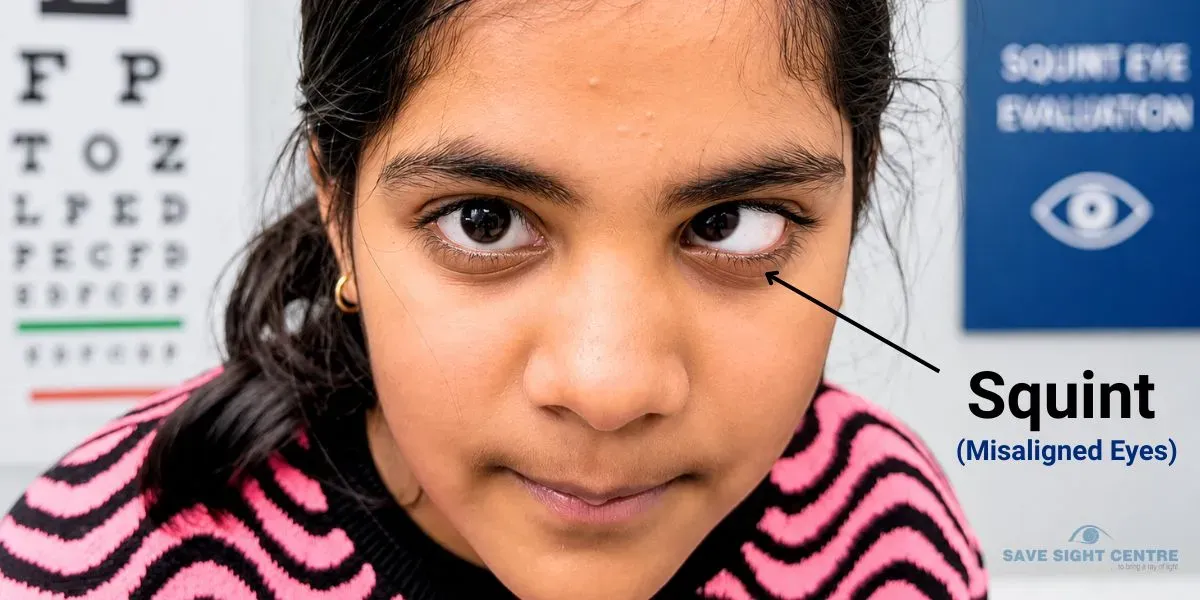
What Is a Squint (Strabismus)?
A squint, medically called strabismus, is when one or both eyes point inward, outward, upward, or downward instead of looking in the same direction together. This misalignment can be permanent or come and go, and it can affect one eye consistently or alternate between the two.
Squint isn't only a cosmetic issue — it can impair depth perception, coordination, and visual comfort, and in children, it can lead to lazy eye (amblyopia) if left untreated. An early eye exam by a specialist can identify the underlying cause and prevent long-term vision problems.
What Are the Different Types of Squint?
Squint is classified by the direction the affected eye turns:
Hypertropia
The eye turns upwards, away from where it should be pointing.
Hypotropia
The eye turns downwards, away from the expected line of sight.
Esotropia
The eye turns inwards, toward the nose — the most common type in children.
Exotropia
The eye turns outwards, away from the nose.
Could It Just Be a "Pseudo-Squint"?
Before assuming a real squint, it's worth knowing that some babies and young children only appear to have misaligned eyes because of their facial features — a wider gap between the eyes, or a flatter nasal bridge, can create the illusion of a squint when the eyes are actually perfectly aligned. This is called a pseudo-squint, and it's a very common false alarm for worried parents. Only a proper eye exam by a specialist can tell the difference, so it's always worth getting checked rather than guessing.
What Causes Squint?
Squint can occur at any age but usually appears in early childhood. A comprehensive eye examination helps determine the exact cause before any treatment plan is recommended.
Muscle Imbalance
When the eye muscles don't work in coordination, one eye may turn away from where it should be looking.
Refractive Error
Uncorrected myopia or hyperopia can cause eye strain that leads to misalignment over time.
Nerve Abnormalities
Issues in the nerves that control eye movement can directly result in strabismus.
Genetic Factors
Family history plays a major role in many cases of squint.
Trauma or Medical Conditions
Brain injury, thyroid eye disease, or stroke may cause new-onset squint in adults.
Neurological Conditions
Less commonly, conditions affecting the brain's coordination with the eyes can also lead to strabismus — one more reason a full evaluation matters.
What Are the Symptoms of Squint?
Early detection significantly improves treatment outcomes. If you or your child experiences any of these signs, an appointment with a squint specialist can confirm a diagnosis and the right treatment path.
How Is Squint Diagnosed?
A proper diagnosis goes well beyond just looking at the eyes — it involves a set of orthoptic tests to fully understand the alignment issue:
Type & amount assessment: Confirms exactly what kind of squint is present and how significant the misalignment is.
Refraction test: Measures how well the child or adult sees, and whether glasses could help correct the underlying issue.
Binocular vision test: Checks how well both eyes work together as a team.
Fundus examination: Includes checking the fixation pattern to rule out other underlying eye conditions.
Is Surgery the Only Solution?
Not necessarily. Save Sight Centre's squint experts consider non-surgical options first, before recommending surgery:
Corrective lenses or prisms: Glasses or prism lenses can control alignment, especially when refractive error is a contributing cause.
Orthoptic exercises: Eye exercises to enhance coordination and strengthen binocular vision.
Patching for amblyopia: Covering the stronger eye encourages the weaker eye to work harder, helping prevent or treat lazy eye in children.
Botulinum toxin injection: Makes temporary changes to an overactive eye muscle to improve alignment.
When non-surgical means don't correct the alignment, or the squint causes ongoing distress, surgery becomes the best and most permanent solution.
How Does Squint Surgery Work?
Squint surgery is a precise, safe procedure that realigns the eyes by adjusting the muscles responsible for eye movement. The goal isn't just cosmetic improvement — it's better binocular vision and depth perception too. Save Sight Centre's squint surgeons use microscopic techniques and advanced imaging to plan every step.
Recession & Resection
The most common techniques — an overactive muscle is detached and reattached further back (recession), or a weak muscle is shortened and reattached (resection) to rebalance eye position.
Adjustable Suture Surgery
Allows fine-tuning of the eye muscle position after the main part of the surgery, for more precise final alignment.
Posterior Fixation & Muscle Transposition
Specialised techniques used for more complex squints, repositioning muscles to correct specific alignment patterns.
The surgery is performed under local or general anaesthesia depending on the situation. Since it's a day-care operation, you're able to go home the same day.
Who Is a Good Candidate for Squint Surgery?
Constant or intermittent eye misalignment that isn't corrected by glasses.
Double vision or poor depth perception affecting daily life.
Headaches caused by the misalignment.
Previous non-surgical treatments that didn't fully work.
Self-consciousness about eye appearance, or a squint affecting a child's visual development.
Save Sight Centre's experts conduct detailed tests, including ocular motility evaluation and 3D vision analysis, to recommend the best treatment approach for you.
Squint Treatment for Adults vs. Children — Is It Different?
- Best treated around age 3-6 for the best long-term outcomes.
- Primary goal is preventing lazy eye (amblyopia) and supporting normal visual development.
- Often combined with patching and vision therapy alongside surgery if needed.
- Vision and fixation pattern in both eyes are closely tracked as the child grows.
- Common causes include trauma, nerve palsy, or an untreated childhood squint.
- Surgery is done to restore alignment, eliminate double vision, or improve appearance and confidence.
- Some patients briefly experience double vision post-surgery as the brain adjusts — usually temporary.
- Most adults report an instant confidence boost and comfort following surgery.
What Are the Benefits of Squint Surgery?
Corrected Eye Alignment
Restores natural-looking, straight eye position for both cosmetic and functional benefit.
Improved Depth Perception
Better binocular vision makes everyday tasks like driving and reading noticeably easier.
Reduced Eye Strain
Less effort needed to focus, easing fatigue and discomfort from daily visual tasks.
Prevents Lazy Eye in Children
Timely correction protects normal visual development during a child's critical growth years.
Boosted Confidence
Many patients report a genuine improvement in psychological well-being and social confidence.
What Are the Risks of Squint Surgery?
Squint surgery has a strong safety record, especially with an experienced surgeon. As with any surgery, some risks exist:
Redness & Mild Swelling
CommonExpected in the days right after surgery, settling on its own with prescribed drops.
Under- or Over-Correction
MildThe eyes may not land perfectly aligned on the first attempt — sometimes needing a follow-up adjustment.
Temporary Double Vision
MildMore common in adults with long-standing misalignment, as the brain adjusts to the new eye position.
Scarring of Eye Tissue
RareUncommon, and generally doesn't affect vision or eye function.
Infection
RareAs with any surgery, a small infection risk exists, managed with prescribed antibiotic drops.
Damage to Surrounding Tissue
RareVery uncommon in experienced hands, given the precise, microscopic technique used.
Will I See Double Vision After Squint Surgery?
If your eyes have been misaligned for many years, especially as an adult, you may briefly notice double vision after they're realigned — this happens simply because your brain has to adjust to the new eye position. It's generally a transient problem, usually resolving within a few weeks as the brain adapts.
Will I Need More Than One Surgery?
It's not uncommon for more than one operation to be needed. This doesn't mean something went wrong the first time — it usually means fine-tuning is needed to get the best possible alignment. If a squint is especially large, your surgeon may plan a 2-stage surgery from the outset. There's also a small chance of recurrence over time, which is why regular follow-up matters.
What Happens During Recovery?
Most patients experience little discomfort and return to normal activities within a matter of days. An eye pad may stay on briefly and is typically removed the next day. Since it's an external surgery on the eye muscles, there's no effect on your actual vision, and sutures used are usually absorbable, so they don't need to be removed. Some redness is normal initially, but most people can return to work within a couple of days.
Use prescribed eye drops
Apply them regularly as directed to support healing and reduce inflammation.
Avoid rubbing your eyes
Keep hands away from the operated eye while it heals.
Attend every follow-up visit
Regular reviews let your doctor confirm the alignment is holding well.
Limit screen time initially
Give your eyes a break from strain in the first few days after surgery.
Why Choose Save Sight Centre for Squint Treatment?
Personalised Treatment Plans
Every squint is different — treatment plans are designed around your unique case.
Advanced Facilities
A fully modernised hospital for squint surgery and accurate eye muscle assessment.
Transparent Pricing
A clear pricing model with no hidden charges for any procedure.
Proven Track Record
1,70,000+ patients treated over 25+ years, with results patients recommend to others.
We take a step further than just aligning the eyes — from consultation to complete recovery, and under one roof you also have access to glaucoma treatment, cataract surgery, LASIK, and more, whenever the need arises.
What Is the Cost of Squint Surgery in Delhi?
Squint surgery cost can vary from one hospital to another. At Save Sight Centre, squint surgery typically ranges between ₹35,000 to ₹45,000 per eye, with flexible payment arrangements for both children and adults and full price transparency. We recommend booking an appointment for an accurate diagnosis and personalised estimate.
Dr. Himshikha Aggarwal, Squint Specialist, Save Sight Centre
"One of the biggest myths I hear from parents and adults alike is that squint is something you just have to live with. It isn't — with the right diagnosis, most squints can be meaningfully corrected at any age. What matters most is figuring out the actual cause first: a refractive squint needs glasses, not surgery, while a muscle-based squint may need precise surgical correction. That's why every patient gets a full evaluation before we recommend a treatment path."
Frequently Asked Questions About Squint Treatment
Treatment of squint in adults depends on its severity. In most instances, squint specialists at Save Sight Centre guide patients toward glasses, prism lenses, or vision therapy to align the eyes. When those options aren't enough, surgery is advised. Botox injections are also used in some cases to relax an overactive eye muscle and improve coordination.
Squint surgery in adults offers both cosmetic and visual benefits. It improves eye alignment and depth perception, making everyday tasks like driving and reading more comfortable. Many Save Sight Centre patients also report a real boost in confidence at work and in social settings, along with improvement in eye strain and double vision.
Generally, squint surgery is not painful because it's carried out under local or general anaesthesia. Mild discomfort or redness can occur for a couple of days afterward, easily managed with eye drops and simple painkillers.
The best time for treatment is during childhood, around 3 to 6 years old, since this helps prevent lazy eye and supports normal visual development. That said, surgery can be performed successfully in adults too, whenever it's needed.
Squint cannot be fully corrected with home remedies alone. Mild cases may see some relief with glasses, patching, or vision therapy, but squint is usually caused by a muscle imbalance, nerve issue, or refractive error that needs to be properly diagnosed by a specialist. Save Sight Centre finds the best outcomes come from early, professional evaluation.
No surgery has a guaranteed 100% success rate, but squint surgery has a high overall success rate. Most patients see significant improvement in eye appearance and alignment. Success depends on factors like age, type and severity of squint, and consistent follow-up care — some patients may need a second procedure for an optimal result.
Yes, LASIK can typically be performed after squint surgery, provided your eye power is stable and your eyes are healthy. Squint surgery corrects eye alignment, while LASIK corrects your vision power — they're two distinct procedures. An eye exam at Save Sight Centre will confirm the right timing for LASIK after squint correction.
Eye exercises can support coordination and reduce strain but do not permanently correct squint on their own. The pencil push-up, where you focus on a pencil as it moves toward your nose, is a commonly recommended exercise. Always do these under the guidance of a specialist, since done incorrectly they can worsen symptoms rather than help.
A pseudo-squint is when a child's eyes look misaligned because of facial features like a wide gap between the eyes or a flat nasal bridge, but there is no actual muscle or alignment problem. It's a common false alarm for parents. Only a proper eye exam can tell the difference between a pseudo-squint and true strabismus.
Some adults, especially those whose eyes have been misaligned for many years, may briefly experience double vision after surgery as their brain adjusts to the newly aligned eye position. This is usually temporary, resolving within a few weeks as the brain adapts.
It's not uncommon to need a second procedure. This doesn't mean the first surgery failed — it usually means fine-tuning is needed for the best possible alignment. Very large squints are sometimes planned as a 2-stage surgery from the start.
Genetics is a significant factor. If you have a family history of squint, your own risk of developing it is higher, though not everyone with a family history will develop strabismus. Save Sight Centre still recommends a thorough eye exam to identify the exact cause in every case.
There's a small chance of recurrence after squint surgery, which may need additional treatment. Attending your scheduled follow-up visits at Save Sight Centre helps catch any drift in alignment early, when it's easiest to manage.
Struggling With Eye Misalignment or Double Vision?
Don't delay treatment — talk to our squint specialists at Save Sight Centre, Adarsh Nagar, North Delhi. NABH & ISO accredited · 25+ years · 1,70,000+ patients treated.
Disclaimer: For general awareness only, not medical advice. Please consult an eye specialist at Save Sight Centre to determine the best procedure for your eyes. Results vary by person. Figures cited are approximate and based on general clinical patterns and published research.