
A brown spot on the eye is a small dark or pigmented area that appears on the white part (sclera), the coloured part (iris), or the surface layer (conjunctiva) of the eye.
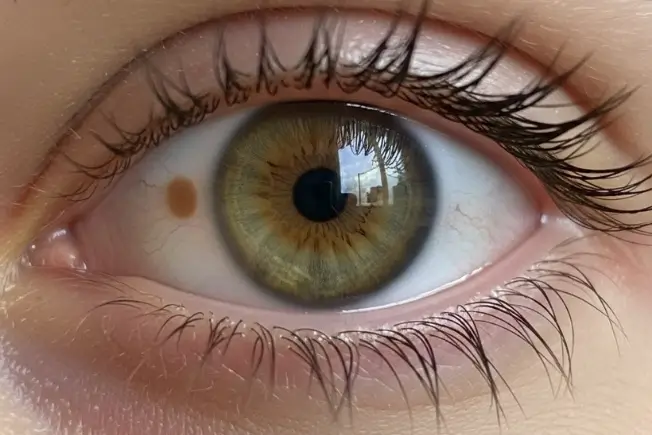
These spots form because of melanin, the natural pigment that gives colour to our eyes, skin, and hair.
Other common names include:
Most brown spots are harmless and do not affect vision. Some people are born with them, while others notice them later in life. However, if the spot changes in size, shape, or colour, it should be checked by an eye specialist.
Several factors can lead to the development of a Brown Spot on Eye.
Some people naturally have more melanin. If eye freckles run in your family, you may develop one too.
Long exposure to ultraviolet rays increases melanin production and may cause brown spots in eyes.
As we grow older, pigmentation changes can slowly appear in the eyes.
Eye infections, irritation, or some medicines may lead to pigmentation changes.
In rare cases, a brown spot may be a sign of ocular melanoma (eye cancer). This is uncommon but requires early diagnosis.
The following are the types which are seen in persons:
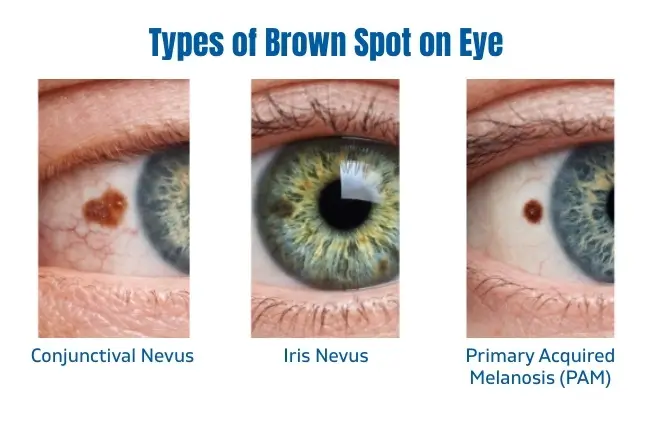
1. Around 5–10% of people may develop iris freckles.
2. Conjunctival nevus is common in children and young adults.
3. PAM usually affects middle-aged or older adults.
4. Ocular melanoma is rare.
The good news: Most brown eye spots are non-cancerous.
You may have a higher chance of developing a brown eye spot if you:
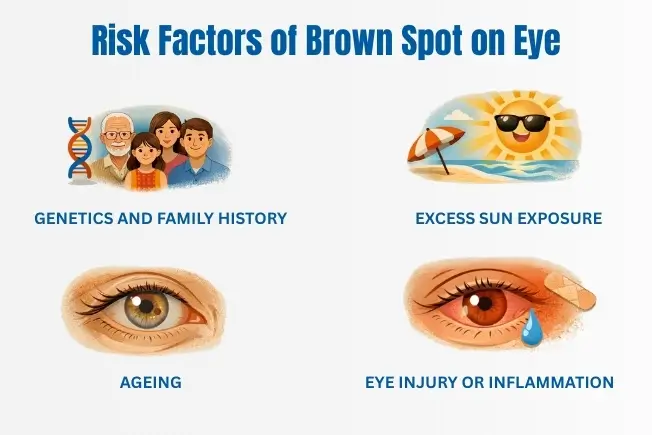
People with family history of eye freckles may develop pigmentation.
UV radiation is one of the major causes of pigmented eye spots.
Age-related changes increase melanin deposits in eye tissues.
Chronic irritation may lead to pigmentation changes.
1. Small and flat brown spot
2. No pain
3. No vision problems
4. No change over time
1. Rapid increase in size
2. Change in colour or irregular borders
3. Raised or thick spot
4. Redness, irritation, or blurred vision
5. Bleeding from the spot
If you notice any of these symptoms, consult an eye specialist immediately.
You can monitor your eye safely at home:
| Feature | Brown Spot on Eye | Skin Mole |
|---|---|---|
| Location | Inside or surface of eye | Skin surface |
| Risk Monitoring | Requires ophthalmologist | Requires dermatologist |
| Impact | May affect vision | Usually cosmetic |
| Treatment | Eye-specific laser or surgery | Skin procedures |
You should consult an eye doctor if you notice:
Early consultation helps prevent complications and ensures safe treatment.
Doctors use advanced technology to examine brown eye freckles.
Provides detailed magnified view of the eye.
Tracks changes in pigmentation over time.
Check thickness and depth of lesions.
Performed only when cancer risk is suspected.
Treatment depends on the type and severity of the pigmentation.
Most harmless spots require observation only.
Used for cosmetic removal of non-dangerous pigmentation.
Recommended when malignancy or discomfort occurs.
Used in rare melanoma cases with advanced technology.
Though prevention is not always possible, risk can be reduced by:
Most people live comfortably with brown pigmentation in the eye without any vision problems. Regular monitoring helps detect early changes. Understanding harmless and dangerous eye freckles reduces anxiety and improves eye care awareness.
Most cases are harmless eye freckles, but sudden changes in size, shape, or colour require medical evaluation.
Usually, these spots remain stable. Some cosmetic treatments can remove pigmentation if required.
Sudden spots may occur due to UV exposure, ageing, inflammation, or rarely abnormal cell growth.
Treatment includes monitoring, laser removal, or surgery depending on the type and risk level.
Yes, conjunctival nevus often appears in children and usually remains harmless.
Rarely, it may indicate ocular melanoma. Regular eye checkups help early detection.
A Brown Spot on Eye is usually a harmless pigmentation caused by melanin deposits. Most eye freckles remain stable and do not affect vision. However, monitoring size, colour, and shape changes is essential.
Regular eye checkups, UV protection, and early diagnosis help maintain long-term eye health and prevent complications.
Copyright © 2025 | Save Sight Centre | All Rights Reserved.