
 +91-7873-222-000
 WhatsApp

 Book Appointment
Ortho-K Night Lenses: Clear 6/6 Vision Without Glasses, Contacts or Surgery
Ortho-K (orthokeratology) lenses are custom night lenses you wear only while you sleep. They gently reshape your cornea overnight, so you wake up and see clearly all day — no glasses, no daytime lenses, no cutting or laser involved.
Quick Answer
Ortho-K lenses are specially designed rigid lenses worn overnight to gently reshape the front surface of your eye (the cornea) while you sleep. When you remove them in the morning, your cornea holds its new shape, giving you clear vision all day — without glasses or daytime contact lenses. The effect is temporary and fully reversible: stop wearing them, and your cornea gradually returns to its original shape.
Key Takeaways
- Ortho-K corrects myopia, hyperopia and mild astigmatism by reshaping the cornea overnight — no surgery involved.
- Lenses are worn only at night (6-8 hours) and removed each morning for glasses-free days.
- Clinically proven to slow myopia progression in children by roughly 40-50% compared to glasses alone.
- Fully reversible — if you stop wearing the lenses, your natural corneal shape and original power return.
- Best suited to low-to-moderate myopia with limited astigmatism, confirmed by corneal mapping.
- Cost at Save Sight Centre starts from ₹50,000 for both eyes, including fitting and initial reviews.
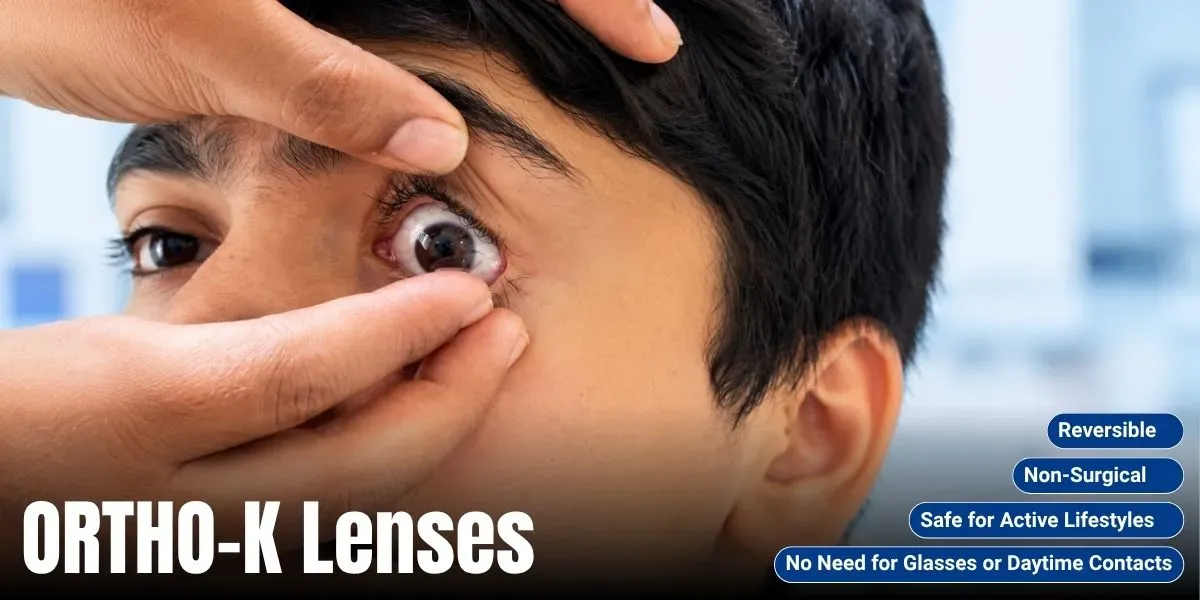
What Are Ortho-K Lenses?
Ortho-K lenses, short for orthokeratology, are specially designed rigid, oxygen-permeable contact lenses. Unlike regular contact lenses that are worn during the day, Ortho-K lenses are worn only overnight. As you sleep, the lens gently presses on the tear film covering your cornea, flattening its curvature just enough to correct how light focuses on your retina.
By morning, your cornea holds this new shape on its own — so you can take the lenses off and see clearly through the entire day, without needing glasses or daytime contact lenses. Think of it as a reversible, non-surgical "vision reset" that you repeat every night.
How Do Ortho-K Lenses Work While You Sleep?
Each Ortho-K lens is custom-designed from a detailed map of your cornea (captured using our Pentacam corneal topographer). The lens has a special reverse-geometry shape that creates a thin layer of tear fluid between the lens and your cornea. This tear layer lets the lens apply very gentle, even pressure that flattens the central cornea overnight — a process called corneal reshaping.
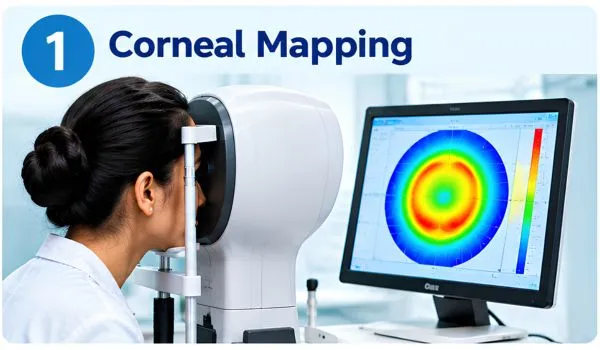
Corneal Mapping
Pentacam topography captures your exact corneal shape so your lenses are designed for your eyes, not a standard template.
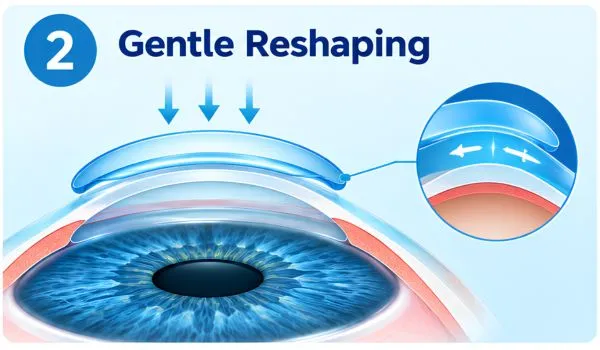
Gentle Reshaping
Worn for 6-8 hours while you sleep, the lens gently flattens the cornea's curvature using controlled pressure.
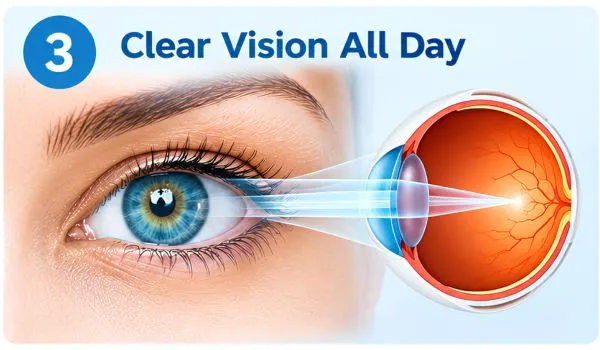
Clear Vision All Day
Remove the lenses each morning — light now focuses correctly on your retina for sharp, natural vision.

Repeat Each Night
The correction typically lasts 12-24 hours, so nightly wear is needed to keep vision clear day after day.
How Long Do I Need to Wear Ortho-K Lenses Each Night?
Most patients need a minimum of 6-8 hours of overnight wear for the cornea to reshape properly and hold its new curve through the following day. Occasionally, your specialist may recommend a few extra hours or more frequent wear in the early weeks until your target correction is reached.
Who Is a Good Candidate for Ortho-K Lenses?
Ortho-K works well for a wide range of people, but suitability always depends on a detailed eye exam and corneal mapping. Here's who typically benefits most:
Children with rising myopia — a proactive way to slow progression while giving glasses-free days at school and play.
Adults tired of glasses or daytime lenses — especially those with low-to-moderate myopia who want a reversible alternative to surgery.
Athletes and swimmers — freedom from fogging, slipping or losing glasses and contacts during sport.
Those not yet eligible for LASIK — too young for surgery, or waiting for a stable power before considering it.
People in dusty or screen-heavy jobs — where daytime lenses cause dryness or discomfort.
Who Should Avoid Ortho-K Lenses?
Ortho-K isn't right for everyone. Your specialist will check for these before recommending it:
High Power or Astigmatism
Myopia or astigmatism beyond the treatable range for your corneal shape may not respond well to Ortho-K.
Irregular Cornea / Keratoconus
Standard Ortho-K is usually unsuitable for keratoconus or an unstable corneal surface — specialised lenses may be needed instead.
Dry Eye or Ocular Surface Disease
Significant dryness can affect lens comfort and corneal health, so this needs to be managed first.
Difficulty With Lens Hygiene
Since Ortho-K success depends on daily cleaning, anyone unable to maintain strict hygiene may be better suited to another option.
Can Ortho-K Lenses Slow Myopia in Children?
Yes — this is one of the most well-studied benefits of Ortho-K. As a child's eye grows, myopia tends to increase year on year. Peer-reviewed research shows that wearing Ortho-K lenses overnight can meaningfully slow this progression compared to ordinary glasses, which is why it has become a widely recommended part of myopia management for children in India and worldwide.
Ortho-K is a management option that may slow myopia progression — it is not a guaranteed cure, and it does not stop a child's power from increasing entirely. Results vary and need ongoing specialist supervision.
What Happens If I Stop Wearing Ortho-K Lenses?
Nothing permanent. Ortho-K's corneal reshaping is temporary by design — if you stop wearing the lenses, your cornea gradually returns to its natural shape over a few days, and your original glasses power comes back. This is exactly why it's considered such a safe, low-risk option: there's no lasting change to the structure of your eye, unlike with laser surgery.
What Are the Benefits of Ortho-K Lenses Over Glasses and LASIK?
No Daytime Glasses or Lenses
Wake up and see clearly without reaching for glasses or inserting daytime contacts.
Fully Reversible
Unlike LASIK, nothing is cut or permanently altered — stop anytime and your cornea returns to normal.
Great for Sports & Swimming
No lenses to lose, no glasses to fog up or break during physical activity.
Natural Night Vision
Since nothing is surgically altered, Ortho-K doesn't cause the glare or halos some people notice after LASIK.
Ortho-K vs LASIK vs Glasses: Which Is Right for You?
- Non-surgical, worn overnight, fully reversible.
- Suitable for children (myopia control) and adults not yet ready for surgery.
- Corrects low-to-moderate myopia and mild astigmatism.
- Needs nightly wear and daily lens cleaning to maintain results.
- Starts from ₹50,000 for both eyes.
- One-time laser procedure; permanent correction.
- Only for adults 18+ with a stable power for at least 6 months.
- Can correct higher powers than Ortho-K.
- Clear vision within 24 hours in most cases; minimal daily maintenance after healing.
- Starts from ₹20,000 and can go up to ₹90,000, depending on the type.
| Point | Ortho-K | LASIK | Glasses / Day Lenses |
|---|---|---|---|
| Surgery involved? | No | Yes | No |
| Reversible? | Yes, fully | No | Yes |
| Daytime freedom | Yes | Yes | No / lenses needed |
| Suitable for children | Yes | Not until adulthood | Yes |
| Slows myopia progression | Yes, studied for this | No | No (single-vision) |
| Results visible | 5-7 days, often faster | Within 24 hours | Immediate |
| Cost (both eyes) | From ₹50,000 | ₹20,000-₹90,000 | Ongoing, recurring |
What Is the Step-by-Step Ortho-K Fitting Process?
Consultation & Eligibility
A detailed eye exam and discussion of your vision goals with your Save Sight Centre specialist.
Corneal Mapping
Pentacam topography maps your exact corneal shape to design lenses specifically for your eyes.
Trial & Dispensing
Trial lenses are fitted, and you're trained on insertion, removal and hygiene before your first night's wear.
Vision Settles
Clarity improves over the first few nights; stable 6/6 vision is typically reached within 1-2 weeks.
Ongoing Reviews
Periodic check-ups confirm fit, eye health and results, with lens adjustments made as needed over time.
Is Ortho-K Safe? What Are the Risks and Side Effects?
When fitted by a trained specialist and worn with good hygiene, Ortho-K has a long, well-documented record of safe use worldwide, including in children. As with any contact lens, most risks come down to how well the lenses are cleaned and cared for.
Initial Discomfort
CommonMild awareness of the lens for the first few nights while your eyes adjust.
Temporary Dryness or Glare
MildSome wearers notice mild dryness or light haloing during the early adjustment period.
Over- or Under-Correction
MildVision may need fine-tuning through a lens adjustment at your follow-up visit.
Corneal Infection
RareRare, but the most serious risk — almost always linked to poor lens hygiene or overdue reviews.
All contact-lens wear carries some risk. Follow your hygiene and wear instructions closely, attend every scheduled review, and report any pain, redness or blurring to Save Sight Centre promptly.
How Much Do Ortho-K Lenses Cost in Delhi?
At Save Sight Centre, Ortho-K lens fitting typically starts from ₹50,000 for both eyes, covering the initial fitting, trial lenses and early follow-up reviews. Your exact cost depends on your power, the complexity of your corneal shape, and whether astigmatism correction is needed — higher powers and cylindrical corrections cost more due to the custom lens design involved.
Get The Exact Cost And Suitability For Your Eyes
Fill the form below:
Book a free Ortho-K trial fitting at Save Sight Centre — our team will confirm your slot by phone.
Thank you! Your trial request is received.
Our Ortho-K team will call you shortly to confirm your free trial slot. For urgent queries, call 7873222000.
How Do I Clean and Care for My Ortho-K Lenses?
Clean every morning
Use only the cleaning solution your specialist recommends, right after you remove the lenses.
Store properly
Keep lenses in a clean case with fresh solution — never reuse old solution — to prevent bacterial build-up.
Never skip reviews
Regular check-ups let your specialist confirm the lenses still fit well and your eyes stay healthy.

Dr. Rajeev JainDirector · Retina, Cataract, LASIK & Uvea Specialist
"Ortho-K is one of the most reassuring options I offer parents of children with rising myopia — it's completely reversible, and the myopia-control benefit is backed by real research. The most important part isn't the lens itself, it's the fitting and follow-up: a well-mapped cornea and consistent reviews are what make Ortho-K both effective and safe."
Frequently Asked Questions About Ortho-K Lenses
Ortho-K lenses don't have a fixed expiry date and can usually be used for 3-4 years with proper care. Save Sight Centre will advise replacement once the lens material loses its shape, gets scratched, or shows any other damage that could affect your corneal health.
Usually not. Save Sight Centre does not recommend standard Ortho-K lenses for Keratoconus or any irregular, unstable cornea. In some early keratoconus cases, our specialists may consider it after a thorough examination, but most keratoconus patients are better suited to specialised lenses like RGP, Rose-K or scleral lenses.
No. Ortho-K only corrects refractive power temporarily — it does not treat lazy eye (amblyopia) or squint. Save Sight Centre offers separate treatments such as patching, vision therapy or squint correction for these conditions.
At Save Sight Centre, Ortho-K typically corrects myopia up to about -8.00D and astigmatism up to about -3.00D, though this depends on your individual corneal shape. Some cases outside this range may still work after a detailed evaluation.
Not usually. Ortho-K works best for minus power (myopia). It is not very effective for plus power (hyperopia), and while some advanced lens designs claim limited correction for low plus power, results are unpredictable — your Save Sight Centre specialist can confirm suitability.
Yes, many patients can use Ortho-K after C3R (corneal cross-linking), but only once your cornea is confirmed fully stable by a Save Sight Centre specialist. A proper checkup and corneal mapping are needed before starting.
Most patients notice a major improvement after the very first night and reach functional vision within 3-7 days. Stable 6/6 vision usually takes 1-2 weeks, depending on your starting power and how your cornea responds.
Yes. The cost at Save Sight Centre increases with higher myopia and with cylindrical (astigmatism) power, since these require more complex, custom lens designs.
Ortho-K suits a wide age range. Save Sight Centre finds it especially effective for children aged 6-18 for myopia control, while adults up to 40-50 can also use it if their corneas are healthy and their power falls within the treatable range. There is no strict upper age limit — suitability depends on corneal health.
Many candidates do use Ortho-K for government medical exams since it gives clear, glasses-free vision during the day. However, this depends entirely on the specific exam's rules — some only check current vision, not how it was achieved. Always confirm the latest guidelines for your exam.
Missing one night usually causes only a mild, temporary drop in clarity, since the corneal reshaping effect fades gradually over a few days without lenses. Wearing the lenses again the following night generally restores clear vision. If you miss several nights in a row, check with your Save Sight Centre specialist.
Most wearers feel mild awareness of the lens for the first few nights, which settles as the eyes adjust. Save Sight Centre trains every patient on correct insertion and removal to keep this initial adjustment period as comfortable as possible.
For children, Ortho-K is generally the better option since LASIK is not performed until the eyes and prescription are fully stable in adulthood. Ortho-K is also clinically proven to help slow myopia progression in growing children, which LASIK does not address.
When fitted and monitored by a qualified specialist and cleaned correctly every day, Ortho-K has a strong long-term safety record with no proven lasting damage. The main risk is infection from poor lens hygiene, which is why Save Sight Centre schedules regular follow-up reviews for every Ortho-K patient.
Regular contact lenses are worn during the day simply to correct vision while worn. Ortho-K lenses are worn only at night and work by actively, temporarily reshaping the cornea, so your eyes stay clear all day even after you remove them.
Curious If Ortho-K Is Right for You or Your Child?
Get a corneal mapping and candidacy check at Save Sight Centre, Adarsh Nagar, North Delhi. NABH & ISO accredited · 25+ years · 1,70,000+ patients treated.
Disclaimer: For general awareness only, not medical advice. Please consult an eye specialist at Save Sight Centre to determine the best procedure and lens suitability for your eyes. Results vary by person. Figures cited are approximate and based on general clinical patterns and published research.