
 +91-9210-914-391
 WhatsApp

 Book Appointment
Refractive Surgery for Thin Cornea: Safe LASIK Alternatives
Being told your cornea is "too thin for LASIK" can be genuinely disheartening, especially if you were counting down to life without glasses. The good news: a thin cornea rarely means surgery is off the table entirely — it just means the safest path forward looks a little different. Here's exactly why thickness matters, and which alternatives are worth discussing with your surgeon.

Quick Answer
A thin cornea isn't a disease — it's simply a measurement, and it varies between people much like height or weight. It matters for refractive surgery because procedures like LASIK remove corneal tissue to reshape the eye, and removing too much from an already-thin cornea can weaken it, raising the risk of a complication called corneal ectasia. The average cornea measures 540-560 microns; most surgeons become cautious below roughly 500 microns. This doesn't rule out surgery — flapless surface treatments (PRK, TransPRK, SmartSurf) and ICL (which removes no corneal tissue at all) are safe, effective alternatives for many patients with thin corneas.
Key Takeaways
- The average cornea is 540-560 microns thick; most surgeons get cautious about standard LASIK below roughly 500 microns.
- What matters isn't thickness alone, but whether at least 250-300 microns can safely remain after treatment, which depends on your prescription too.
- Corneal ectasia — progressive bulging from a weakened cornea — is the main risk of removing too much tissue, though it's uncommon with proper screening.
- Flapless surface treatments (PRK, TransPRK, SmartSurf) avoid flap-related weakening and suit many thin-cornea patients.
- ICL removes no corneal tissue at all, making it a strong option for very thin corneas or high prescriptions.
- A thin cornea is not the same as keratoconus — but proper topography screening is essential to rule the latter out before any laser surgery.
Figures reflect general clinical guidelines and can vary by surgeon, laser technology, and individual eye anatomy.
Why Does Corneal Thickness Matter for Refractive Surgery?
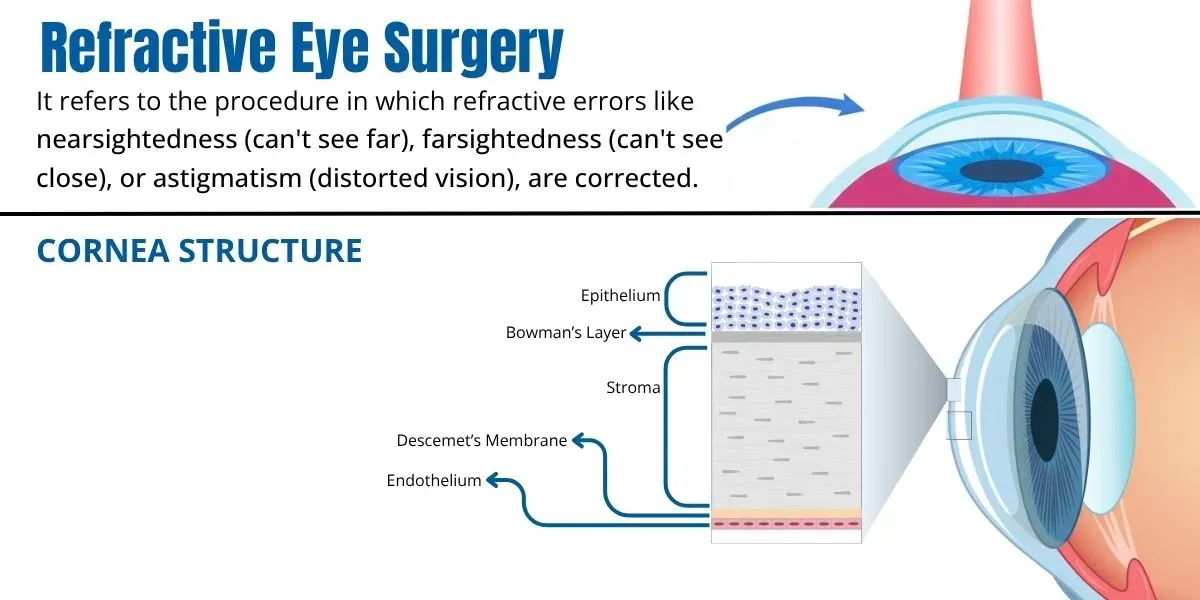
The cornea is the clear, dome-shaped front part of your eye that helps focus light — and its thickness varies from person to person, much like height or weight. The average cornea measures between 540 and 560 microns (thousandths of a millimetre) at its centre. When the cornea measures thinner than roughly 480-500 microns, most surgeons become cautious about standard LASIK, though there's no single universal cutoff, since your prescription matters just as much as raw thickness.
Here's why: procedures like LASIK create a thin flap and then remove tissue beneath it to reshape your cornea and correct your vision. The higher your prescription, the more tissue needs to be removed. After treatment, a minimum of roughly 250-300 microns must remain untouched to preserve the cornea's structural strength. For example, a cornea measuring 510 microns, with a 120-micron flap and needing 250 microns left untouched, leaves only about 140 microns available to treat your prescription — which may not be enough for a higher-power correction. This is exactly why thin cornea and high prescription together, rather than thinness alone, is what most often rules out standard LASIK.
What Is Corneal Ectasia, and Why Is It the Main Risk?
Corneal ectasia is a progressive, irreversible bulging and thinning of the cornea that can develop when too much tissue is removed during laser surgery, leaving the remaining structure too weak to hold its shape. It's uncommon — occurring in well under 1% of properly screened refractive surgeries — but it's serious enough that thorough pre-surgical screening is treated as essential, not optional. Surgeons now also calculate a metric called percent tissue altered (PTA) — the proportion of your total corneal thickness affected by the proposed treatment — since a PTA above roughly 40% is linked to meaningfully higher ectasia risk, even in corneas that look structurally normal on an initial scan.
Why Might Standard LASIK Not Be the Best Choice?
In conventional LASIK, the surgeon creates a thin flap on the cornea, then uses a laser to reshape the tissue beneath it. This means a portion of tissue is used to create the flap, and further tissue is removed to correct your power. If the cornea is already thin, or your prescription is high, standard LASIK can leave too little tissue behind, weakening the cornea over time. This is why most advanced surgeons will not perform flap-based LASIK on thin corneas, and will instead recommend alternatives that use less — or no — corneal tissue at all.
What Are the Safer Refractive Options for a Thin Cornea?
There are three main categories of procedures commonly considered for patients with thin corneas:
Surface Ablation (PRK, TransPRK, SmartSurf)
FlaplessPRK (Photorefractive Keratectomy): An older flapless method — the thin outer layer of the cornea (epithelium) is gently removed, the laser reshapes the surface directly, and the epithelium naturally regrows over a few days.
TransPRK / SmartSurf (No-Touch Surface Laser): The latest, more advanced flapless versions, where the laser removes the epithelium and reshapes the cornea in a single step with no blades or instruments touching the eye at all.
Because no flap is created, these avoid flap-related weakening entirely, making them a strong choice for many thin-cornea patients.
ICL (Implantable Collamer Lens)
No Tissue RemovedA completely different approach: a thin, flexible lens is inserted behind the iris and in front of your eye's natural lens — like a permanent contact lens placed inside the eye, rather than on its surface.
Advantages for thin corneas: corneal thickness and strength are fully preserved; high degrees of myopia and astigmatism can often be corrected safely; the lens can be removed or exchanged later if needed, making it reversible; and quality of vision post-surgery is generally excellent.
Save Sight Centre offers ICL surgery for patients where laser options are limited or less safe.
Special Surface and Combined Approaches
Selected CasesIn select cases, options like Epi-LASIK or carefully planned topography-guided surface surgery may be considered, tailored to specific corneal patterns using high-quality imaging. In eyes with early corneal weakness or irregularity, your doctor may also discuss corneal collagen cross-linking to strengthen the cornea, sometimes combined with limited laser correction.
Note: SMILE (Small Incision Lenticule Extraction) is another modern option, but like LASIK, it still removes corneal tissue, so it faces similar thickness constraints and isn't typically the answer for very thin corneas.
Is a Thin Cornea the Same as Keratoconus?
No, and this distinction matters enormously for safety. A thin cornea is simply a measurement — plenty of people have naturally thin, perfectly healthy, and structurally normal corneas. Keratoconus is a distinct, progressive disease where the cornea gradually thins and bulges into an irregular, cone-like shape, and it is a strict contraindication for LASIK and most laser refractive surgery, since operating on it can dramatically worsen the condition. This is exactly why corneal topography or tomography — which map the cornea's shape, not just its thickness — is considered essential before any refractive surgery decision, rather than relying on a thickness measurement alone.
Which Option Typically Fits Your Situation?
| Your Situation | Often Considered |
|---|---|
| Mildly thin cornea, low-to-moderate power | TransPRK / SmartSurf |
| Thin cornea with high myopia or astigmatism | ICL |
| Irregular topography or early corneal weakness | Cross-linking ± staged laser correction |
| Normal topography, borderline thickness | Surface ablation after PTA calculation |
| Confirmed or suspected keratoconus | Laser surgery ruled out; cross-linking / specialty lenses discussed |
This is a general guide — your specific combination of thickness, shape, and prescription determines the actual recommendation.
How Does Save Sight Centre Evaluate Thin Cornea Patients?
For anyone with a suspected thin cornea, the evaluation is more detailed and careful. Common tests include:
- Corneal thickness measurement (pachymetry)
- Corneal topography or tomography to assess shape and rule out conditions like keratoconus
- Tear-film and dry eye assessment
- Complete eye examination, including retina and eye pressure
Based on these findings, your doctor will help you understand whether a surface laser (PRK/TransPRK/SmartSurf) is safe and suitable, ICL is a better choice given your thickness and power, a combined or staged approach is needed, or continuing with glasses/contacts is the safest plan for now.
What Can You Expect During Recovery?
Recovery depends on which procedure is chosen for your thin cornea:
PRK / TransPRK / SmartSurf
Mild discomfort in the first few days, with watering, light sensitivity, and a foreign-body sensation. Functional vision usually returns in 3-4 weeks and continues sharpening over the following weeks.
ICL Surgery
Vision often improves noticeably within the first 24-48 hours. Mild glare or halos may be noticed initially and usually reduce with time and follow-up care.
What Makes You a Good Candidate for ICL Specifically?
ICL tends to suit patients with higher degrees of myopia or astigmatism that a laser can't safely correct given the available corneal tissue. Beyond your prescription and corneal thickness, your surgeon will also check your anterior chamber depth (the space behind the cornea, in front of the iris) to confirm there's enough room for the lens, and your corneal endothelial cell count, since these cells don't regenerate and need to stay healthy long-term. These additional checks are exactly why a full workup — not just a thickness measurement — determines true ICL candidacy.
Dr. Rajeev JainDirector · Retina, Cataract, LASIK & Uvea Specialist
"Refractive surgery for a thin cornea is a highly individualised process at Save Sight Centre — every patient goes through a detailed work-up including corneal scanning, pachymetry, topography or tomography, and a complete eye examination before we recommend anything. A 'thin cornea' isn't a single verdict; it's one data point among several that, together, tell us which path is genuinely safest for your eyes."
Frequently Asked Questions About Refractive Surgery for Thin Cornea
No. A thin cornea may rule out standard LASIK, but options like PRK, TransPRK/SmartSurf, and ICL can still be safe and effective for many patients after proper evaluation.
Surface surgeries (PRK and TransPRK/SmartSurf) are favoured by many thin cornea patients since they don't create a flap, avoiding the flap-related weakening seen with standard LASIK, making them generally safer in these eyes.
ICL is typically advised when the cornea is too thin, the power required is too high to safely correct with a laser, or the corneal shape isn't suitable for laser surgery. It's also considered when patients want high-quality, reversible vision correction without altering the corneal structure at all.
Recovery time depends more on the type of procedure than on corneal thickness itself. Surface treatments like PRK/TransPRK have a slower initial recovery than LASIK, while ICL usually offers quick visual recovery within a few days.
The best procedure can only be decided after detailed tests of corneal thickness, shape, eye power, and overall eye health by an experienced refractive surgeon. At Save Sight Centre, all these factors are reviewed before recommending SmartSurf, ICL, or any other approach, keeping your long-term corneal safety as the top priority.
There's no single universal cutoff, since it depends on your prescription as much as raw thickness. The average cornea measures 540-560 microns centrally, and most surgeons become cautious below roughly 500 microns. What ultimately matters is whether enough tissue — generally at least 250-300 microns — can safely remain untouched after treatment, which depends on how much correction your eyes need.
Corneal ectasia is a progressive, irreversible bulging and thinning of the cornea that can occur when too much tissue is removed during laser surgery, weakening its structure over time. It's uncommon — occurring in well under 1% of properly screened refractive surgeries — but it's serious enough that thorough pre-surgical screening for corneal thickness and shape is considered essential rather than optional.
Percent tissue altered (PTA) is a calculation surgeons use to estimate how much of your total corneal thickness would be affected by a proposed laser treatment, combining flap thickness and ablation depth. A PTA above roughly 40% is associated with a meaningfully higher risk of ectasia, even in corneas that look structurally normal on initial screening, which is why it's checked as an extra safety measure before your surgeon commits to LASIK.
No, they're related but distinct. A thin cornea is simply a measurement — many people have naturally thin, perfectly healthy corneas. Keratoconus is a progressive disease where the cornea thins and bulges into an irregular, cone-like shape, and it's a strict contraindication for LASIK and most laser refractive surgery. This is exactly why corneal topography or tomography, not just a thickness measurement, is essential before any refractive surgery decision is made.
SMILE (Small Incision Lenticule Extraction) is another modern refractive option, but like LASIK, it still removes corneal tissue to reshape the eye, so it faces similar thickness constraints. For corneas that are genuinely very thin, surface treatments (PRK/TransPRK) or ICL — which removes no corneal tissue at all — are generally the safer, more suitable choices, though your surgeon will confirm which applies to your specific eyes.
Told Your Cornea Is Too Thin for LASIK?
Get a thorough evaluation and personalised recommendation at Save Sight Centre, Adarsh Nagar, North Delhi. NABH & ISO accredited · 15+ years · 1,70,000+ patients treated.
Disclaimer: The information on this site should not be considered medical advice. Please consult a doctor for determining the best procedure as well as the most appropriate lens for your eyes. Results may vary from person to person and we do not guarantee similar results for everyone.