
 +91-7873-222-000
 WhatsApp

 Book Appointment
ICL Surgery: Vision Correction for Powers LASIK Can't Safely Treat
ICL, or phakic IOL surgery, corrects your vision by implanting a tiny lens inside the eye — without removing or reshaping any corneal tissue. It's the go-to option for very high refractive errors, thin corneas, and anyone told they're "not fit for LASIK."
Quick Answer
ICL (Implantable Collamer Lens) surgery, also called phakic IOL surgery, corrects refractive errors by placing a soft, biocompatible lens inside the eye — positioned behind the iris and in front of your natural lens — without touching or reshaping the cornea at all. It's especially valuable for people with very high myopia, thin corneas, or stable keratoconus, where LASIK or SMILE isn't a safe option. The lens is fully reversible, and most patients no longer need glasses or contact lenses for their original refractive error afterward.
Key Takeaways
- ICL corrects myopia up to around -20D, hyperopia beyond +6D, and astigmatism up to about 6D — ranges often outside what LASIK can safely treat.
- Because no corneal tissue is removed, ICL is fully reversible and preserves the eye's natural focusing system (accommodation).
- A key eligibility factor is Anterior Chamber Depth (ACD) — the space where the lens sits needs to measure at least 2.75-3.0mm.
- A dilated retina check is essential before ICL, since high myopia raises the risk of retinal weak spots that may need treatment first.
- Surgery itself takes just 10-15 minutes per eye through a small, self-sealing 3mm incision — no stitches needed.
- Costs at Save Sight Centre range from ₹1,30,000 (Spherical) to ₹1,90,000 (Toric) — call or WhatsApp 7873222000 for current pricing.
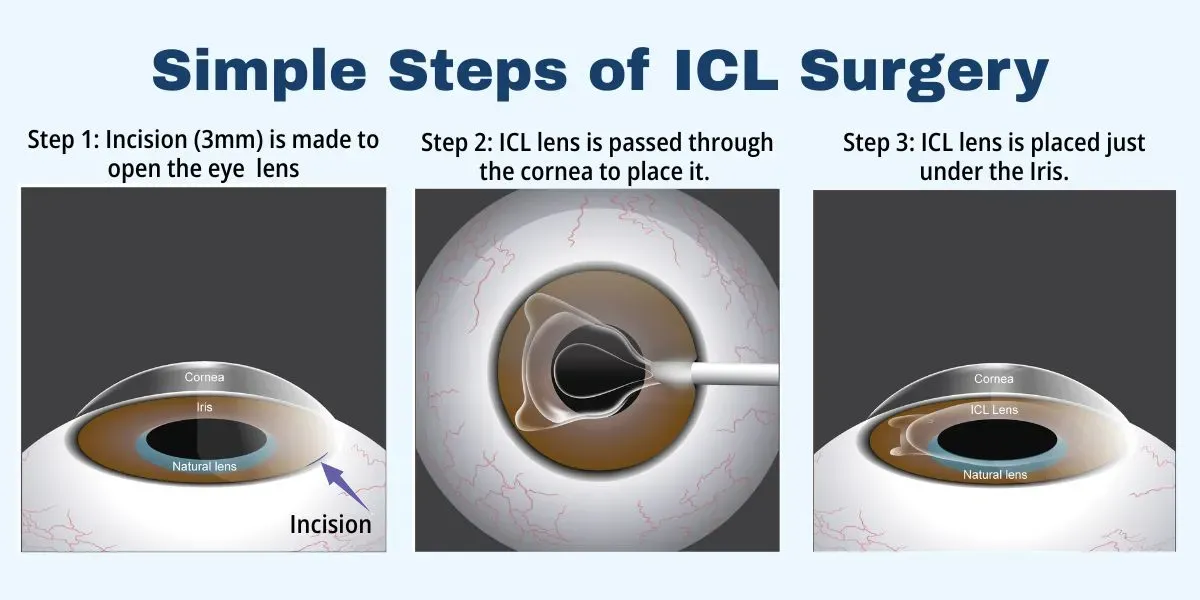
What Is ICL or Phakic IOL Surgery?
ICL is commonly referred to as "phakic IOL" (phakic intraocular lens), and it has been used safely around the world for more than two decades. ICL stands for Implantable Collamer Lens — a type of vision correction surgery where a tiny, soft lens is implanted inside your eye to correct refractive errors. It provides freedom from glasses for many people, especially those who aren't suitable candidates for laser eye surgery.
What Power Range Can ICL Correct?
One of ICL's biggest advantages is treating refractive errors far beyond what laser surgery can safely handle:
| Refractive Error | Typical Treatable Range With ICL |
|---|---|
| Myopia (minus power) | Up to approximately -20D |
| Hyperopia (plus power) | Beyond +6D |
| Astigmatism (cylinder) | Up to approximately 6D |
Your exact treatable range is confirmed after a full pre-surgery evaluation of your eyes.
Who Is Suitable for ICL Surgery?
Adults with near-sightedness (myopia), and in many cases, far-sightedness (hyperopia) and astigmatism.
People with high power that cannot be safely treated with LASIK or SMILE.
People with thin corneas, or stable keratoconus, where laser reshaping may not be safe.
Anyone with well-controlled diabetes — this alone is not a reason to rule out ICL.
General candidacy: at least 18 years old, spectacle power stable for around a year (minor changes are fine), not pregnant or breastfeeding, and no active eye disease.
How Is Your Eligibility for ICL Determined?
A detailed pre-ICL workup is what makes this surgery safe and precise — this isn't a routine eye check:
Refraction & visual acuity: Confirms your exact spectacle power and how it's affecting your vision.
Anterior Chamber Depth (ACD): The critical measurement — the space between your cornea and natural lens where the ICL will sit needs to be at least 2.75-3.0mm.
Corneal topography (Pentacam): Maps your cornea's shape and rules out irregularities.
Pachymetry: Measures corneal thickness as part of your overall eye-health profile.
Intraocular pressure (IOP) & corneal diameter: Additional measurements used to size and select the safest lens for your eye.
Why Does Your Retina Need to Be Checked Before ICL?
ICL is usually chosen for high spectacle powers (high myopia), and highly myopic eyes are more prone to retinal weak spots, tears, or holes that can raise the risk of retinal detachment later. A thorough, dilated retina evaluation is a non-negotiable step before ICL surgery. If any weak areas are found, a quick, painless barrage laser treatment is done first, and the retina is given about 2-3 weeks to stabilise before ICL surgery goes ahead.
What Are the Benefits of ICL Surgery?
Sharper Quality of Vision
Since the lens sits close to the eye's natural focusing point, many patients enjoy notably sharper, clearer vision.
The Cornea Is Never Altered
A great option for thin corneas or stable keratoconus, since no corneal tissue is touched, cut, or removed.
Corrects Very High Powers
ICL gives excellent vision even at high refractive errors like -20D or more, where other refractive surgeries may not work.
Built-In UV Protection, No Maintenance
Modern ICLs like EVO ICL include UV protection and need no daily cleaning, unlike external contact lenses.
No Risk of Corneal Weakening
Since the cornea isn't affected, there's no risk of corneal ectasia — a weakening that can occur after some laser procedures.
Globally, ICL has an outstanding track record — patient satisfaction rates commonly cited above 99% across millions of implants worldwide since it was first approved, and roughly 95% of patients no longer need glasses or contacts for their original refractive error afterward.
What Types of ICL Are Available?
Spherical ICL
Corrects simple myopia or hyperopia — used when power is significant but astigmatism (cylinder) is low.
Toric ICL
Corrects cylinder alongside spherical power — ideal for people with both high power and significant astigmatism.
Most modern ICLs, such as the EVO Visian ICL, include UV protection and are made from biocompatible material designed to remain safely in the eye long-term.
How Does ICL Surgery Work?
ICL surgery is done as day-care surgery — you're admitted on the day of the procedure and go home the same day.
Topical Anaesthesia
Numbing drops are used — no injections into the eye are needed.
Small Incision
A tiny, self-sealing 3mm incision is made at the edge of the cornea.
Lens Folded & Inserted
The soft lens is folded to pass through the small incision.
Lens Unfolds Into Place
It settles behind the iris and in front of your natural lens, working with your eye's normal focusing system.
Eye Rinsed
The eye is rinsed with antibiotic solution to reduce infection risk before you head home.
The whole procedure typically takes just 10-15 minutes per eye, and no stitches or bandage are needed thanks to the self-sealing incision.
What Precautions Should You Follow Before and After Surgery?
Before: Antibiotic Drops
Start prescribed antibiotic eye drops a few days before surgery, and avoid eye makeup in this period.
After: Rest & Ease Back In
Rest for 1-2 days, then gradually resume light activity; wait about a week before visually demanding work.
Avoid Strenuous Activity
Skip vigorous exercise for about a month, and avoid water splashing directly into your eyes, swimming, and eye makeup for the same period.
Complete Your Medication Course
Continue prescribed drops for about 2-4 weeks and attend every scheduled follow-up.
What Is the Recovery Timeline?
Mild discomfort and blurry vision are common on the day of surgery — this settles as your eye adjusts to the new lens. Vision typically becomes clearer over the following days. A follow-up review happens the day after surgery, then weekly for several weeks to confirm everything is healing well. If both eyes need treatment, the second eye is usually done 3-5 days after the first at Save Sight Centre.
What Are the Risks of ICL Surgery?
ICL is a very safe procedure overall, and proper screening beforehand greatly reduces these already-low risks:
Temporary Discomfort & Blurred Vision
CommonExpected for a few hours after surgery, settling as the eye adjusts.
Increased Eye Pressure
MildCan occur temporarily, monitored and managed at your follow-up visits.
Dry Eye or Light Sensitivity
MildTemporary and usually resolves during the healing process.
Infection
RareUncommon with proper technique and post-op care, but always monitored closely.
Accidental Damage to the Natural Lens
RareExtremely uncommon in experienced hands, and closely guarded against with careful technique.
Is ICL Surgery Reversible?
Yes — this is one of ICL's standout advantages. Because no corneal tissue is removed or reshaped, the lens can be taken out or replaced at any point in the future if your vision needs change. This flexibility isn't available with laser vision correction, where the corneal reshaping is permanent.
Can You Get ICL If You Have Keratoconus?
ICL can be a genuinely good option for select keratoconus patients — but only once the condition is stable. Your surgeon will typically want to confirm your refraction and glasses power have been unchanged for about two years, with a clear central cornea and no significant surgical intervention needed to control the condition. This is considered an off-label use of the lens, though it's widely practiced and accepted worldwide. Visual results in keratoconus patients tend to be somewhat less predictable than in eyes without the condition, so your surgeon will set realistic expectations based on your specific case. Read more about keratoconus and its treatment.
Special Consideration: Can ICL Surgery Be Done During Pregnancy?
It's best to wait. Pregnancy hormones can cause fluctuations in tear production and even change your cornea's curvature, temporarily altering your glasses power. Since ICL sizing depends on precise, stable measurements, it's advisable to wait until after delivery — and preferably around six months after stopping breastfeeding — before considering surgery, so your eyes' true refractive status can be confirmed.
ICL vs. LASIK (Laser Specs Removal)
Both ICL and LASIK help you get rid of glasses, but they achieve it in very different ways, and each suits different eyes:
| Factor | ICL | LASIK / SMILE |
|---|---|---|
| Position | Inserts a thin lens inside the eye, in front of your own lens | Uses a laser to reshape the cornea itself |
| Cornea | Not removed or reshaped — remains structurally intact | Permanently reshaped; not reversible |
| Reversibility | Reversible — lens can be removed or replaced | Not reversible |
| Power range | Very high powers, outside the safe LASIK range | Mild to moderate powers, with adequate corneal thickness |
| Cornea profile | Suitable for thin or irregular corneas | Needs a cornea thick and regular enough for safe laser reshaping |
Best Eye Surgeon & Hospital in Delhi for ICL Surgery
When you choose a surgeon for ICL, you're trusting them with the inside of your eye — so experience and technology matter more than anything else. That's where a dedicated refractive centre like Save Sight Centre makes a real difference.
NABH & ISO Accredited
25+ years of specialised eye care and 1,70,000+ patients treated.
Experienced Refractive Surgeons
Dr. Rajeev Jain and team perform LASIK, ICL, IPCL and other specs-removal procedures routinely, not occasionally.
Detailed Pre-ICL Workup
Corneal topography, anterior segment imaging and internal eye measurements, to ensure proper sizing and safe lens selection.
Strong Record With Complex Cases
High myopia, thin corneas, and patients previously told "not fit for LASIK" — where ICL becomes the safer option.
How Much Does ICL Surgery Cost in Delhi?
ICL surgery cost in Delhi varies depending on lens brand, hospital setup, and package inclusions (tests, follow-ups, etc.). At Save Sight Centre, ICL surgery ranges between ₹1,30,000 for Spherical and ₹1,90,000 for Toric. For exact, updated pricing, call or WhatsApp 7873222000.
For comparison, LASIK at most Delhi centres is quoted in the ₹20,000-60,000 per eye range — ICL costs more due to the price of the custom lens and the detailed workup involved.

Dr. Rajeev JainDirector · Retina, Cataract, LASIK & Uvea Specialist
"ICL has been genuinely life-changing for patients who came to us after being told LASIK wasn't an option — very high power, a thin cornea, or early keratoconus. What people don't always realise is how much of the outcome depends on the workup, not just the surgery itself — getting the Anterior Chamber Depth and lens sizing exactly right, and never skipping the retina check in high myopia, is what makes ICL both safe and reliably excellent."
Frequently Asked Questions About ICL Surgery
Yes. ICL surgery is a well-established and safe procedure when done by an experienced eye surgeon. The lens material is biocompatible and designed to stay inside the eye long term. Proper screening before surgery greatly reduces risks.
Yes. One major advantage of ICL is that it is reversible. The lens can be removed or replaced if required in the future. This is not possible with most laser vision correction procedures.
Yes, in many cases, both eyes can be treated with ICL in the same sitting, if your eye doctor thinks it is safe for you. At Save Sight Centre, surgeons recommend that one eye be done first and the second eye later (after 3-5 days).
Yes. You will typically be asked to discontinue contact lenses a few days before your pre-surgery measurements are taken to allow your cornea to return to its natural shape. Your doctor will let you know exactly how long, depending upon your lens type (soft, toric or hard).
No. The ICL sits behind the coloured part of your eye (iris), so it is not visible to other people and your eye looks completely natural. Even you will not feel or seldom see the lens in normal daily life after the eye has healed.
An IOL will normally be implanted after the removal of the natural lens in a cataract operation, whereas an ICL is positioned in front of your natural lens, without removing it, primarily for the removal of spectacles in eyes that are otherwise clear.
ICL can be taken into consideration in selected patients with keratoconus, where the disease is stable, and who have been treated or stabilised. Your surgeon will only recommend ICL if it is safe for your stage and pattern of keratoconus.
ICL can typically correct myopia up to around -20D, hyperopia beyond +6D, and astigmatism (cylinder) up to about 6D — powers that are often outside the safe range for LASIK or SMILE. Your exact treatable range depends on your eye's individual measurements.
ICL is usually performed for high spectacle powers (high myopia), and highly myopic eyes are more prone to retinal weak spots, tears or holes. A thorough dilated retina evaluation is essential beforehand — if any weak areas are found, a quick, painless barrage laser treatment is done first, and the retina is given 2-3 weeks to stabilise before ICL surgery proceeds.
Yes, most likely. ICL corrects your existing spectacle power, but it does not prevent presbyopia — the natural, age-related loss of near-focusing ability that affects almost everyone after 40. You may still need reading glasses at that stage, regardless of having had ICL surgery.
It's best to wait. Refractive surgeries like ICL are elective and are best planned after delivery, and preferably about six months after stopping breastfeeding, since pregnancy hormones can temporarily change your cornea's curvature and your glasses power, making accurate ICL sizing unreliable during this time.
ICL has an excellent track record globally, with patient satisfaction rates commonly cited above 99% across millions of procedures performed worldwide since it was first approved. Around 95% of patients no longer need glasses or contact lenses for their original refractive error afterward.
The Anterior Chamber Depth is the space between your cornea and your eye's natural lens, where the ICL sits. It needs to be at least around 2.75-3.0mm for an ICL to fit safely without crowding nearby structures. This measurement is one of the most critical parts of your pre-surgery eligibility screening.
Told You're "Not Fit for LASIK"? Ask About ICL
Get a detailed ICL evaluation at Save Sight Centre, Adarsh Nagar, North Delhi. NABH & ISO accredited · 25+ years · 1,70,000+ patients treated.
Disclaimer: For general awareness only, not medical advice. Please consult an eye specialist at Save Sight Centre to determine the best procedure and lens for your eyes. Results vary by person. Figures cited are approximate and based on general clinical patterns and published research.