
Cataract makes the natural eye lens opaque and therefore form a vision through a foggy window. MICS is a method of Cataract Surgery. It applies modern equipment to inflict minimal pain and facilitate a fast healing process. This is valued by patients in Delhi because most prefer to remain offline due to busy schedules. One can go back to work in several days after the procedure. The procedure requires the replacement of the damaged lens with a clear artificial one, and no big scars or stitches are left.
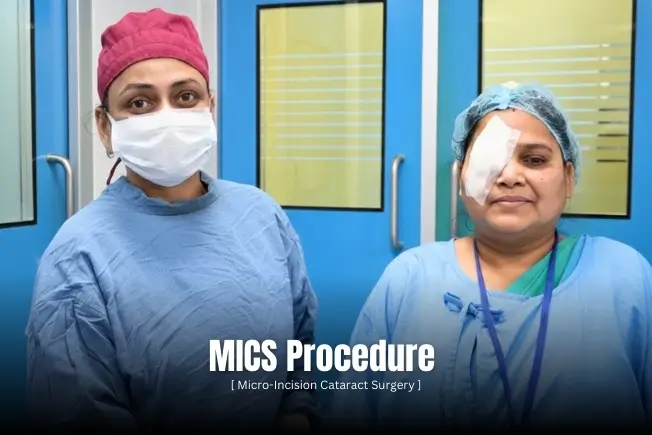
This is beneficial in keeping the eye strong and healthy in the long run. Women over 60 and men over 70 often choose this option first. The fear of surgery diminishes because of the simplicity and safety of MICS. The recovery process is much quicker than the methods used many years ago.
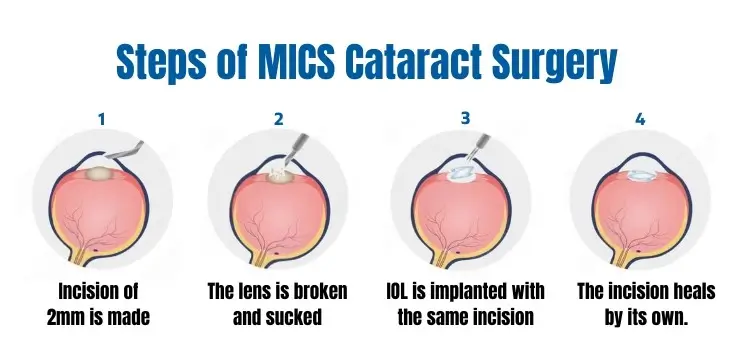
MICS is the abbreviation of Micro-Incision Cataract Surgery. It is a small incision on the periphery of the eye, between 1.8 and 2 mm in height. Conventional surgeries had bigger holes, approximately 3 mm. This size is smaller, thus swelling is limited and the shape of the eye is preserved. The ultrasound waves during the process shred the cloudy lens into minute fragments, which are removed by suctioning via the same minute opening.
The cataract surgeon will implant a folded artificial lens in the eye, which will unfold naturally. The new lens does not require any stitches and remains in place, thus reducing the chances of infection. Improvement in vision is often perceived immediately by the patients. MICS is becoming popular in India because its success rate is high, standing at 98 percent. The glasses may still be required after the surgery to aid in reading. Premium lenses included in MICS aid in both distance and near vision, helping individuals avoid spectacles.
Individuals with blurred vision caused by cataracts require MICS surgery. The common symptoms include difficulty seeing road signs in low light or faded colours on the television. Headlight glare makes driving hazardous. It is also hard to read small print. Regular eye checks help detect issues early. Do not wait until vision deteriorates. MICS is effective for those seeking quick recovery and is suitable for the elderly with active lifestyles. It can be safely performed on diabetics with controlled blood sugar levels. Glaucoma patients qualify after pressure tests, and it is also suitable for those with thin corneas.
MICS outperforms older methods for treating astigmatism, preventing the formation of new distortions in the eye. Women tend to experience less swelling after surgery, whereas men prefer a brief hospital stay. All patients experience less discomfort and a quicker return to normal life.
The MICS Procedure involves several steps to ensure the patient feels comfortable and the procedure proceeds smoothly.
Follow-up visits happen on day one, then week one and month one. Vision starts clearing within hours for many. Drops fight germs and swelling during healing. Doctors explain all steps before so fears stay low. In Delhi, clinics offer same-day checks for convenience. You'll drive home soon if the other eye sees well.
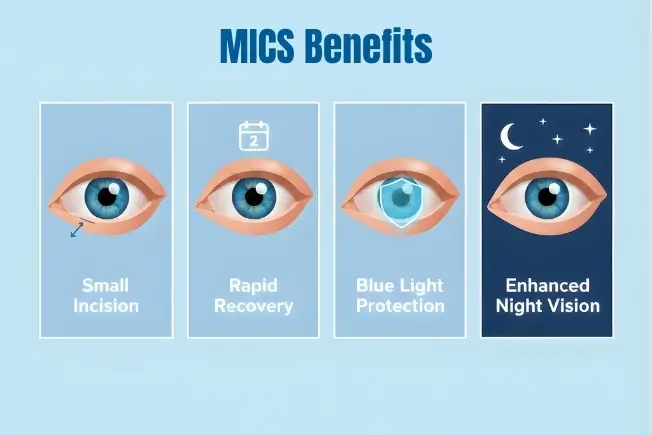
The following are the most common and best benefits of MICS:
MICS surgery on cataracts ranges between Rs. 30,000 and 1,50,000 per eye.
The experience of doctors and machines in hospitals is also value-adding. Preoperative scans of the OPD are sometimes expensive. Basic MICS are usually covered by insurance, helping patients with the financial assistance needed.
Government programs are of much assistance to the rural folks. We advise you to compare prices, but select competent centres among the lowest prices. No secret charges of drops or shields in good places. The prices increased by ten percent in the previous year due to improved imports. Delhi clinics also have packages with checks. Quicksave is through fast recuperation and a reduced number of leave days. Glasses long term reduces expenditures.
MICS uses cuts under 2 mm while traditional phaco needs 2.2 to 3 mm. Healing with MICS happens forty percent faster. Patients also require less pain medication. Risks from wound stretching are eliminated. The energy needed to break the lens remains lower in MICS. This always offers better protection for weaker eyes. The chances of infection are easily halved. Both methods remove the lens in the same fundamental way. MICS suits busy lifestyles perfectly.
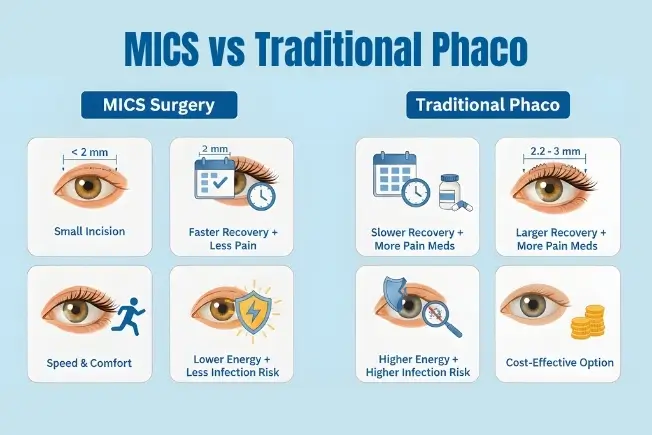
Traditional methods may be more suitable for tighter budgets. Success rates are nearly one hundred percent with either option. Choose MICS for overall speed and comfort. Traditional methods are a good choice if cost is the main concern. Doctors will guide you fully based on your eye health.
We, the team of Cataract Surgeons like Dr. Shuchi Gupta and Dr. Ankit Malhotra, led by Dr. Rajeev Jain at Save Sight Centre, in Delhi, prefers to use MICS on microscopic cuts and enormous outcomes. At Save Sight Centre, the doctors scan the eyes to choose the perfect lenses and plans based on personal preferences.
The personal care is what differentiates us from other clinics. Doctors and surgeons tend to the needs and requirements of each patient individually, so that the patient feels safe. Our doctors have proven experience and skills with thousands of surgeries.
MICS cataract surgery proves very safe, with success rates over 98 percent. Tiny cuts lower infection risks to under one percent. Modern tools make it a routine procedure now.
Vision clears in just a few days after MICS surgery. Normal activities resume in one week completely, while total healing usually finishes by month one.
MICS cataract surgery costs Rs. 45000 to 90000 per eye in Delhi. Lens type changes the price the most. Insurance covers the basics often well.
Distance vision needs no glasses with premium lenses after MICS. However, reading might require low-power ones sometimes.
No. Patients do not experience any pain during MICS because drops numb the eye fully. Mild itch follows but eases quickly.
Copyright © 2025 | Save Sight Centre | All Rights Reserved.