
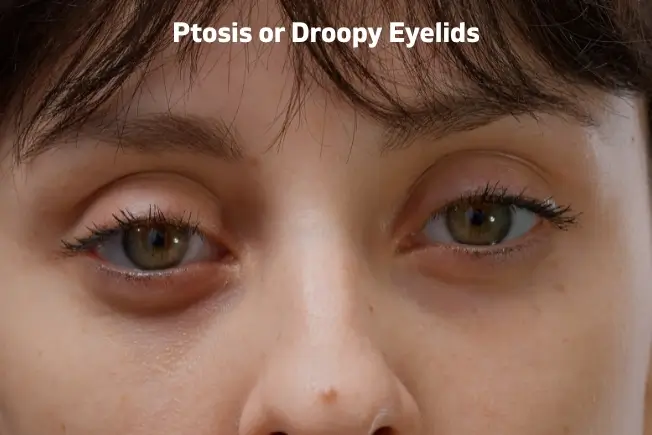
Have you ever noticed that one or both of your upper eyelids seem to hang lower than usual? This condition is called ptosis, which is also known as droopy eyelids. At first, ptosis may seem like a small cosmetic problem, but it can actually make it harder for you to see and make your eyes feel better all day. Some people are born with it, while others get it as they get older or because of other health issues. The good news is that ptosis can be fixed, and in most cases, the results are life-changing.
1. Ptosis (Droopy Eyelid): Causes, Symptoms, Treatment & Surgery Options
2. Ptosis (Droopy Eyelid) - What It Really Means for Your Eyes
3.1 Ageing - The Most Common Reason Behind Droopy Eyelids
3.2 Congenital Ptosis - When Babies Are Born With a Droopy Eyelid
3.3 Nerve and Muscle Problems - Hidden Health Issues Behind Ptosis
4. Warning Signs You Should Never Ignore
5. Diagnosis of Ptosis by an Oculoplastic Surgeon
6. Treatment of Ptosis - Best Options to Fix a Droopy Eyelid
6.1 Ptosis Surgery - The Most Effective Way to Lift a Droopy Eyelid
6.2 Non-Surgical Options - Simple Solutions for Mild Ptosis
6.3 Ptosis Treatment in Children - Protecting Young Eyes Early
7. Recovery After Ptosis Surgery
8. Risks of Ptosis Surgery - What You Should Know Before the Procedure
9. Save Sight Centre's Approach to Ptosis Care
10.1 Is ptosis surgery painful?
10.2 Can ptosis go away on its own?
10.3 At what age should a child with ptosis have surgery?
Ptosis is when the upper eyelid hangs lower than it should. In mild cases, it might just look a little strange. In more serious cases, the eyelid can cover part or all of the pupil, which makes it hard to see clearly. Ptosis can happen to one eye or both eyes, and it can happen at birth or later in life.
The levator muscle, which lifts the eyelid, can become weak, stretched, or injured, leading to the condition. Sometimes, the nerve that controls this muscle is also involved. The treatment plan can be different for each patient, depending on the cause.
There are many reasons why someone may develop a droopy eyelid. Knowing the cause helps the doctor choose the right treatment for each patient. A drooping eyelid is not always just a cosmetic concern. In many cases, it signals an underlying muscle or nerve issue that deserves prompt medical attention.
The most common cause of ptosis is simple ageing. Over time, the muscle and tendon that lift the eyelid can stretch or become weak. This is why many older adults notice their eyelids slowly begin to sag. It often happens in both eyes at the same pace.
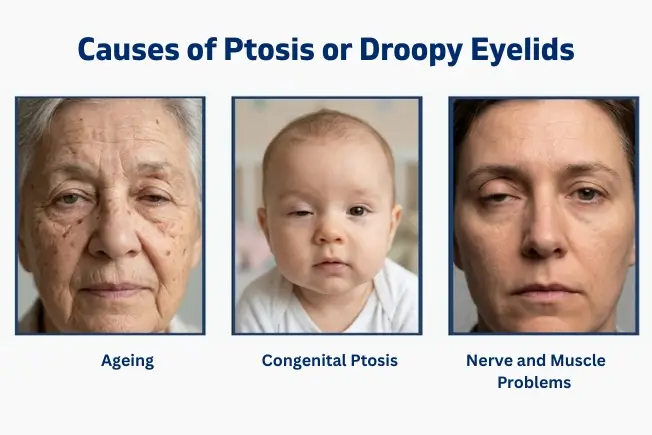
Some babies are born with ptosis because the eyelid muscle did not develop fully before birth. This is called congenital ptosis. If left untreated, it can affect vision development in a child and may lead to lazy eye, so early check-ups are very important.
Certain health conditions, like myasthenia gravis, stroke, or nerve damage, can weaken the muscles that control the eyelid. Eye injuries, long-term contact lens use, and even earlier eye surgeries can also cause ptosis in some people.
The most obvious sign of ptosis is a drooping eyelid. There are other signs, though. You might notice that your eyes look tired, that they are hard to keep open, or that you always have to lift your eyebrows to see better. Some people tilt their heads back to look from under the drooping lid.
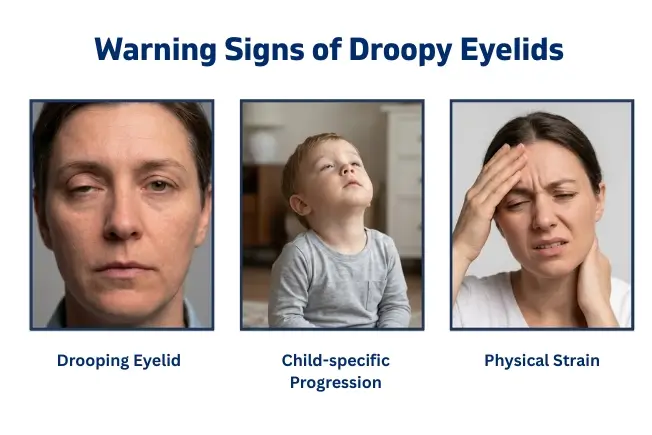
Children with ptosis may rub their eyes a lot or have trouble seeing. It can make things look blurry, hurt your neck from tilting your head, and even give you headaches by the end of the day if your eyelid blocks your pupil. A drooping eyelid that gradually worsens over weeks or months should never be dismissed as simple tiredness.
A simple eye exam is usually enough for an eye doctor to figure out if someone has ptosis. The Oculoplasty doctor will check your overall vision, see how far the eyelid covers the eye, and see how strong the lifting muscle is. Sometimes, blood tests or scans are needed to rule out problems with the nerves or muscles. Early diagnosis is very important for kids to make sure their vision grows normally.
Treatment depends on the cause of the droop, how severe it is, and whether it is affecting vision. For mild cases that do not affect sight, no treatment may be needed. For more serious cases, surgery is usually the best option.
The most effective treatment is a small surgery that tightens or repairs the eyelid muscle. The surgeon lifts the eyelid back to its normal position, improving both vision and appearance. The procedure is usually done under local anaesthesia and takes about one hour.
In some cases, special glasses with a small crutch attached can hold the eyelid up. This is helpful for patients who cannot have surgery due to other health problems. Treating the underlying cause, like managing myasthenia gravis, can also improve the droop in certain patients.
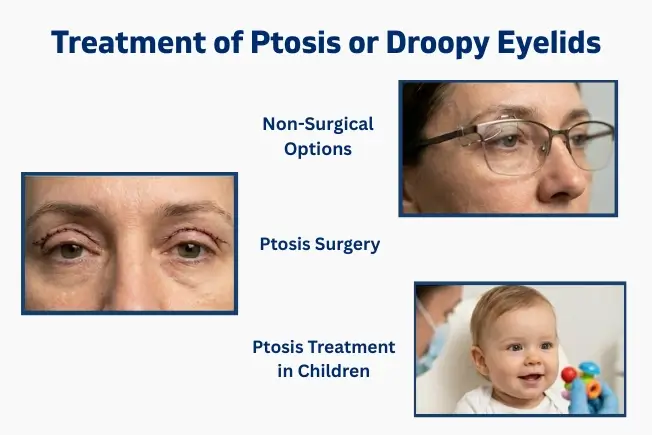
Children with congenital ptosis often need surgery early on to protect their eyesight as it grows. If the droop isn't too bad, the doctor might just keep an eye on the child. Regular eye exams help make sure that the child's vision is growing normally and that they don't get lazy eye.
Most people recover quickly from ptosis surgery. For the first week or two, it's normal for the area around the eye to swell, bruise, and hurt a little. To stop infection and help healing, your doctor will give you eye drops or ointment. In the first few days, cold compresses can also help with swelling.
Most people can go back to light activities within a week, but they should stay away from heavy lifting and hard exercise for a few weeks. You can usually see the final result after the swelling goes down, which can take anywhere from a few weeks to a few months. The doctor can check on the healing and make sure both eyelids are even during follow-up visits.
There are some risks with ptosis repair, just like with any surgery. These can be things like mild asymmetry between the two eyelids, dry eye, infection, or a small amount of over- or under-correction of the lift. In some cases, a second small surgery may be needed to make the result even better. Choosing an eye surgeon with a lot of experience greatly lowers these risks and helps make sure the result looks natural.
Before any treatment is planned, every ptosis patient at Save Sight Centre gets a full eye exam. Our expert Dr. Rwituja Thomas Grover carefully checks the droop, test the strength of the eyelid muscles, and looks for any underlying problems. We use modern surgical methods that leave very little scarring and look natural. We provide gentle, age-appropriate care to children with congenital ptosis and closely monitor their vision as it develops. Before and after surgery, every patient gets clear instructions to make the whole process go smoothly and without stress.
No. You won't feel any pain during the surgery because it is done with local anaesthesia. It's normal to feel some pain and swelling for a few days after the procedure. Your doctor can give you medicine to help with these symptoms.
Most of the time, no. Ptosis that happens because of ageing, weak muscles, or birth defects doesn't get better on its own and usually needs treatment. But ptosis caused by a temporary problem, like swelling or certain nerve issues, may get better once the main problem is fixed.
It all depends on how bad the droop is. If the eyelid is covering the pupil and making it hard to see, surgery may be necessary as soon as possible to avoid lazy eye. If the droop is mild, the doctor might wait to decide until the child is a little older.
No. The surgery is usually done through the natural crease in the eyelid, which hides the scar and makes it fade over time. Once the healing is done, most patients think the result looks very natural.
The results last for a long time in most cases. But natural ageing can cause mild drooping again many years later. If this happens, a quick follow-up procedure can fix it easily.
Copyright © 2025 | Save Sight Centre | All Rights Reserved.