
Vision problems are more common than you might think, and one of the most overlooked yet widespread conditions is astigmatism. Many people live with it for years without even realizing it, often assuming their symptoms are just due to tired eyes or excessive screen time.
If you frequently experience blurred or distorted vision, difficulty focusing on objects, eye strain after long hours of work, or recurring headaches, astigmatism could be the underlying cause. You might also notice trouble seeing clearly at night or the need to squint to get a sharper view.
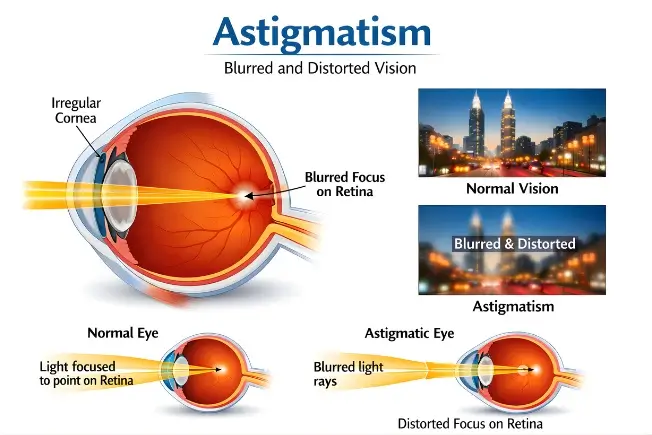
Astigmatism is a common refractive error where the eye does not focus light evenly on the retina, leading to blurred or distorted vision. Normally, the cornea (the front surface of the eye) is perfectly round, like a football. However, in astigmatism, it has an irregular shape more like a rugby ball.
This irregular curvature causes light rays to focus at multiple points instead of one, making both near and distant objects appear unclear.
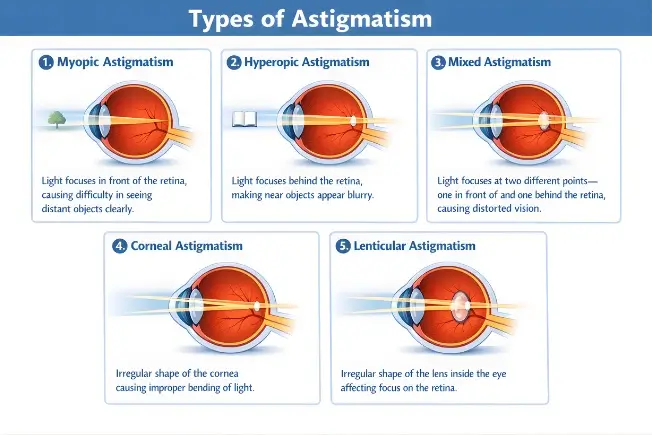
Astigmatism is a common refractive error where the eye does not focus light evenly on the retina, leading to blurred or distorted vision. It can be classified based on where the irregularity occurs and how it affects vision.
This is the most common type of astigmatism and occurs when the cornea (the front surface of the eye) is irregularly shaped.
This type is commonly corrected with glasses, contact lenses, or LASIK.
This type occurs due to irregularities in the lens inside the eye, rather than the cornea.
Treatment depends on the cause and may include glasses or lens-based procedures.
This occurs when astigmatism is combined with nearsightedness (myopia).
It is commonly corrected with cylindrical glasses, contact lenses, or LASIK.
This type combines astigmatism with farsightedness (hyperopia).
Correction options include glasses, lenses, or refractive surgery.
In this complex type, the eye has two different focus points:
This leads to distorted vision at all distances, making it harder to achieve clear focus without correction.
While many people are born with it, several factors can contribute to its development or progression.
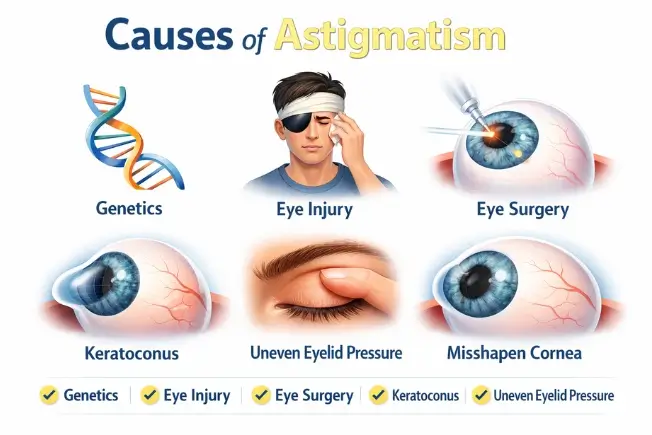
Astigmatism is often inherited and can run in families.
Trauma to the eye can alter the shape of the cornea.
Certain eye procedures can change the natural curvature of the cornea.
This is a progressive condition where the cornea becomes thin and cone-shaped.
Constant or uneven pressure on the eye especially during early development can affect corneal shape.
The symptoms may vary depending on severity, but the most common signs include:
Many people ignore these symptoms, assuming they are due to fatigue or screen time but untreated astigmatism can affect daily life significantly.
Astigmatism can affect learning and development. Kids may struggle to read, write, or focus in school. Early detection is crucial to prevent long-term vision problems.
Adults often experience eye strain, headaches, and reduced productivity due to uncorrected astigmatism. It may also worsen with age or other eye conditions.
The good news is that astigmatism is highly treatable. Depending on severity, several options are available:
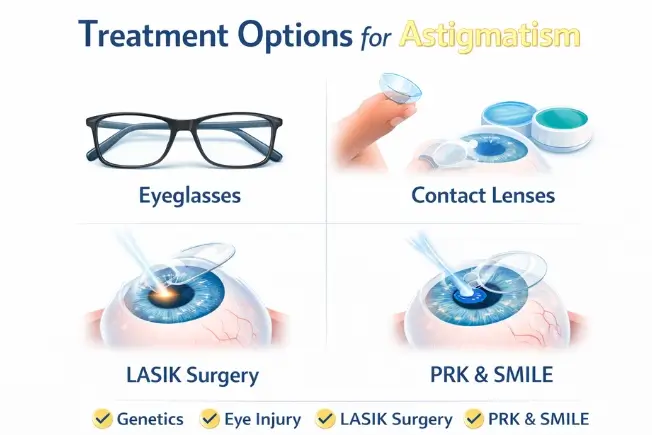
The simplest and most common solution. Special cylindrical lenses help correct the uneven curvature.
Toric lenses are designed specifically for astigmatism and provide a wider field of vision than glasses.
A popular and effective permanent solution. LASIK reshapes the cornea to correct how light enters the eye, providing clear vision without glasses.
Advanced laser procedures suitable for patients who may not be ideal candidates for LASIK.
Yes, astigmatism can change over time, especially due to the following:
However, with regular monitoring and timely treatment, vision can be maintained effectively.
While medical treatment is essential, these tips can help manage symptoms:
You should consult an eye doctor if you notice the following:
Early diagnosis can prevent complications and improve quality of life.
Astigmatism is a common yet manageable vision condition that can significantly impact your daily life if left untreated. The key lies in early detection, proper diagnosis, and choosing the right treatment option.
Whether it’s glasses, contact lenses, or advanced procedures like LASIK, modern eye care offers effective solutions to help you achieve clear, comfortable vision.
Don’t ignore the signs your eyes deserve the best care.
No, it is a common and treatable condition. However, if left uncorrected, it can affect vision quality and daily activities.
Astigmatism does not usually go away on its own, but it can be effectively corrected with proper treatment.
Yes, LASIK is a safe and widely used procedure to correct astigmatism, provided you meet the eligibility criteria.
Yes, children can be born with astigmatism or develop it early in life. Regular eye exams are important.
Blurred vision, headaches, and eye strain are common signs. A comprehensive eye exam is the best way to confirm.
Screen time doesn’t directly cause astigmatism but can increase eye strain and discomfort.
Copyright © 2025 | Save Sight Centre | All Rights Reserved.