
If you’ve been thinking about getting freedom from those specs or contact lenses, chances are you’ve come across LASIK. But there’s a new, more advanced option making waves, known as TransPRK (Transepithelial Photorefractive Keratectomy). Sounds complex? Let’s simplify it.
TransPRK is a completely blade-free, touch-free laser eye surgery designed to correct vision problems like myopia (nearsightedness), hyperopia (farsightedness), and astigmatism. Unlike traditional LASIK, there’s no cutting or creation of a corneal flap. Instead, the laser works directly on the surface of the cornea in a single step.
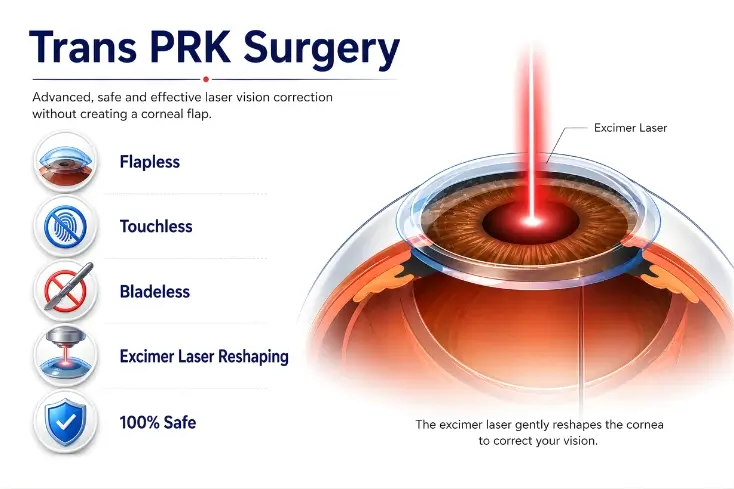
Think of it like polishing a scratched lens-only far more precise and controlled. The laser removes the outermost layer (epithelium) and reshapes the cornea simultaneously, allowing light to focus correctly on your retina.
This technique is especially beneficial for people who were earlier considered unsuitable for LASIK, such as those with thin corneas or active lifestyles.
Traditional LASIK involves creating a flap in the cornea using a blade or femtosecond laser. While effective, it comes with certain risks like flap displacement. TransPRK eliminates this step entirely.
Here’s a quick comparison:
| Feature | TransPRK | Flap-based LASIK |
|---|---|---|
| Flap Creation | No | Yes |
| Contact with Eye | No-touch | Minimal contact |
| Suitable for Thin Cornea | Yes | Often No |
| Recovery Time | Slightly longer | Faster |
| Risk of Flap Complications | None | Present |
The absence of a flap makes TransPRK safer for athletes, defense personnel, individuals with active lifestyles, and those who don't want it to be detected in medical examinations.
Delhi has rapidly evolved into a hub for advanced medical procedures, especially in ophthalmology. With cutting-edge laser technologies and highly trained surgeons like Dr. Rajeev Jain and Dr. Shuchi Gupta, the city offers world-class eye care comparable to global standards.
Many eye centres like Save Sight Centre now use AI-guided laser systems and topography-guided treatments, ensuring unmatched precision and customized results like never before.
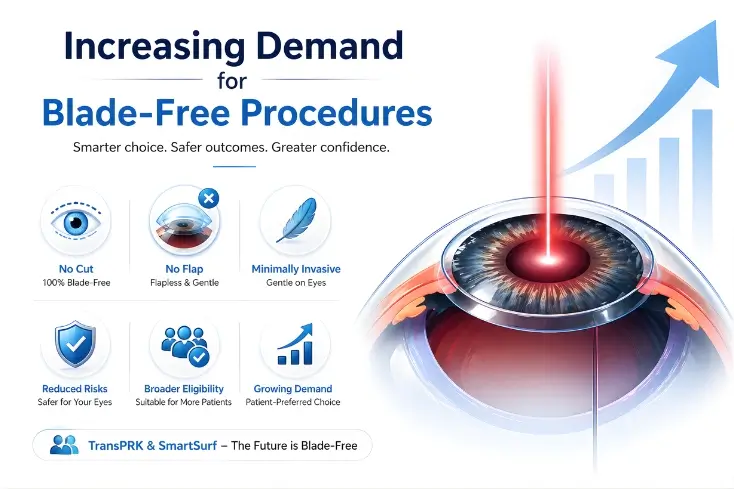
Patients today in 2026 are more informed than ever. The idea of a no-cut, no-flap, and minimally invasive surgery i.e. TransPRK and SmartSurf are naturally appealing. Add to that the reduced risk factors and broader eligibility, and it’s easy to see why TransPRK is becoming the go-to choice.
Before the procedure, your eye doctor conducts a series of tests to check corneal thickness measurement, eye mapping, and vision stability checks. You’ll be advised to stop wearing contact lenses for at least 4-5 days prior.
On the day of surgery, numbing eye drops are used, so you won’t feel pain. It will be just mild pressure.
The surgery itself is surprisingly quick, usually completed in just 10-15 minutes.
All the laser steps are done in one-go.
No blades, no incisions, just pure laser precision.
There are many benefits of TransPRK like as earlier said, It’s touchless, flapless, undetectable in Govt. medical exams, quick procedures, etc. However, It has some additional benefits as explained below:
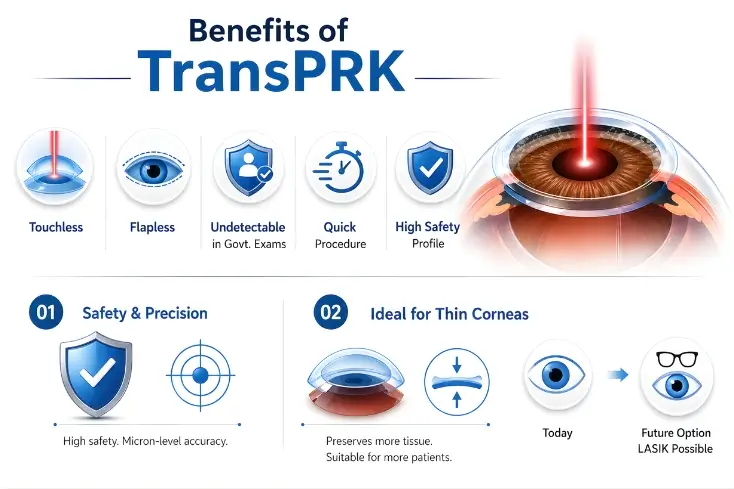
One of the biggest advantages of TransPRK is its high safety profile. Since there’s no flap, complications related to flap healing or displacement are eliminated. The use of advanced laser systems ensures micron-level accuracy, making outcomes highly predictable.
Many people are rejected for LASIK due to thin corneas. TransPRK changes that. It preserves more corneal tissue, making it a viable option for a wider group of patients.
Flapless procedures save more tissues now, so If by any chance, myopia occurs in future, there are possibilities to get the LASIK done again.
It’s very simple, if you can go for LASIK then you can also choose TransPRK Surgery. Moreover, in some cases like thin cornea, where flap-based LASIK is not suitable, you can still go for this flapless procedure. The eligibility criteria is as follows:
Generally, you’re a good candidate if:
Not everyone is suitable. You may need to avoid TransPRK if you have:
You just need to consult an eye specialist, he will guide you to the best suitable LASIK for your eyes after thorough examination and pentacam test.
We at Save Sight Centre, use the latest German technology and our 20+ years of experienced surgeons like Dr. Rajeev Jain & Dr. Shuchi Gupta. The cost of TransPRK LASIK at Save Sight Centre, Delhi is Rs. 60,000/- (Both eyes).
Several elements influence pricing:
Cheaper isn’t always better-this is your vision we’re talking about. On the other hand, we try to make it affordable, so that we can provide this advanced technology to the needy ones.
Unlike LASIK, TransPRK has a slightly longer recovery period.
Patience is key here- the results are worth the wait.
You’ll need to:
Following these steps ensures smooth healing.
Some temporary effects include:
These usually resolve within a few days.
Though rare, complications can include:
Choosing an experienced surgeon minimizes these risks significantly.
Would you trust just anyone with your eyesight? Probably not.
Look for:
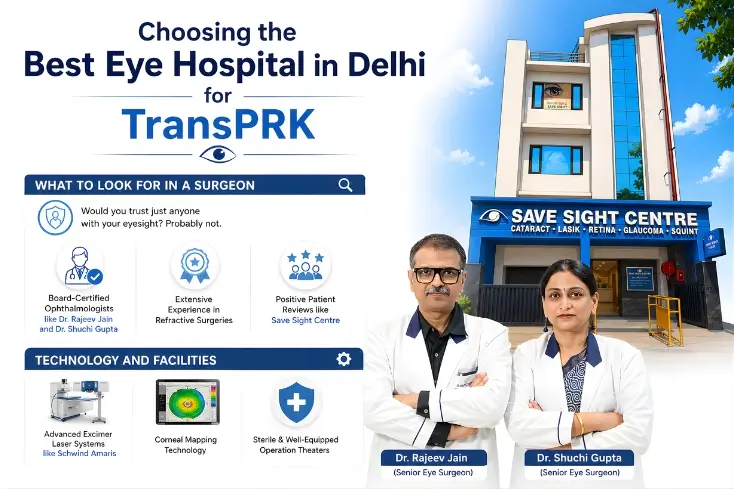
Modern eye hospital should offer:
The right hospital makes all the difference.
TransPRK (Transepithelial Photorefractive Keratectomy) is an advanced, no-touch laser eye surgery that corrects refractive errors like nearsightedness (myopia), farsightedness (hyperopia), and astigmatism. It uses an excimer laser in a single continuous step. Unlike LASIK, TransPRK never cuts a corneal flap.
In LASIK, a thin flap is created in the cornea (with a blade or femtosecond laser), lifted to expose the tissue underneath, reshaped with a laser, and then replaced. This creates the risk of flap-related complications throughout the patient's life.
In TransPRK, the laser first removes the outer epithelial layer of the cornea, then immediately reshapes the corneal stroma- all in one seamless, touchless session. No blade, no flap, no manual contact with the eye whatsoever. This makes it the most hands-off laser eye surgery available today.
TransPRK is particularly well-suited for patients who are excluded from LASIK or prefer a flapless approach. Ideal candidates include:
TransPRK is generally not recommended for patients with unstable prescriptions, active corneal disease, autoimmune conditions affecting healing, or very high refractive errors beyond its correction range (typically up to -10D myopia, +3D hyperopia, -6D astigmatism).
The procedure itself is completely painless. Before surgery, anesthetic eye drops are applied to fully numb the eye. Patients are aware of the laser but feel no pain during the 1–3 minute procedure per eye.
However, the recovery period does involve discomfort. In the first 24-48 hours after surgery, it is common to experience:
Pain typically peaks between days 1-3 and subsides significantly once the epithelium regenerates (usually by day 3-5). Modern platforms like the Schwind Amaris with Smart Pulse Technology have reduced post-operative pain substantially compared to traditional PRK. Surgeons routinely prescribe oral pain relief, anti-inflammatory drops, and lubricating eye drops to manage discomfort during this phase.
Recovery timelines differ significantly between the two procedures:
A bandage contact lens is placed on the eye immediately after TransPRK and usually removed around day 5, once the epithelium has healed. Driving and screen-heavy work should be avoided for the first week.
Full visual stabilization after TransPRK usually takes 2-3 months, though most patients see substantial improvement by the end of the first month. Despite the longer initial recovery, long-term visual outcomes are comparable to LASIK for most patients.
TransPRK has an excellent safety profile, but like all surgical procedures, it carries potential risks:
Notably, TransPRK eliminates all flap-related complications (flap displacement, wrinkles, infection under the flap) that are a lifelong concern for LASIK patients.
All three procedures- TransPRK, LASIK, and SMILE; achieve similar long-term visual outcomes for suitable candidates. The key differences are:
For thin corneas, dry eye, and contact sports, TransPRK or SmartSurf are preferred. For fastest recovery and widest prescription range, LASIK may be recommended by the surgeon.
Yes, the corneal reshaping achieved by TransPRK is permanent. The laser removes tissue that does not regenerate in the same way, so the structural correction does not reverse.
However, there are two important nuances:
In over 95% of treated eyes, residual refractive error after TransPRK is clinically insignificant. A small minority may require an enhancement procedure, which is possible if sufficient corneal thickness remains.
TransPRK has a very high success rate when performed with modern excimer laser platforms. Key outcomes from clinical research include:
Results are best for patients with stable prescriptions within the treatable range and no complicating corneal conditions. An experienced surgeon using up-to-date technology is a key factor in maximizing outcomes.
Before surgery:
After surgery:
TransPRK costs vary by country, hospital, technology used, and surgeon’s experience. As a general guide, the cost of LASIK in Delhi is approximately ₹30,000–₹40,000 per eye depending on the hospital.
TransPRK typically costs more than standard PRK due to the advanced technology involved, but may be comparable to or slightly less than LASIK depending on the place.
Insurance: Refractive surgeries including TransPRK are considered elective procedures by most insurance providers and are generally not covered. Always verify with your insurer and eye hospital in advance. The best approach is to get a written quote from your preferred eye centre that includes all follow-up care costs.
Copyright © 2025 | Save Sight Centre | All Rights Reserved.