
Do nearby things look blurry? Do your eyes feel tired after reading for a while? Do you get headaches after spending time on your phone or computer?
If yes, you might have hyperopia, or as most people call it, farsightedness.
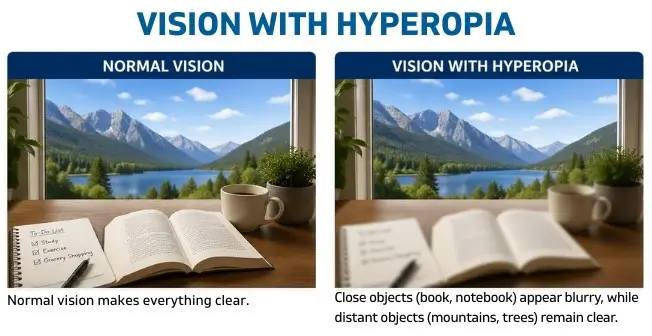
Hyperopia, also known as farsightedness, is a very common eye problem, but many people don’t fully understand it. Unlike myopia (nearsightedness), which is often talked about more, hyperopia usually gets less attention. This is because many people, especially children, can still see clearly for some time as their eyes adjust to it.
However, just because it can be ignored early on doesn’t mean it’s harmless. If hyperopia is not treated on time, it can cause eye strain, headaches, and blurred vision and may even lead to more serious eye issues. Getting the right check-up and treatment at the right time can help prevent these problems and improve overall vision and comfort.
1. Hyperopia: What It Is, Why It Happens, and How to Fix It
3. Is Hyperopia the Same as Presbyopia?
5. What are the Symptoms of Hyperopia?
6. How Is Hyperopia Diagnosed?
7. Treatment Options of Farsightedness?
7.3 Option 3: Laser Eye Surgery
8. Tips for Living Comfortably with Hyperopia
9.1 Is hyperopia the same as presbyopia?
9.2 Is hyperopia the opposite of myopia?
9.3 Can babies be born with hyperopia?
9.4 Does screen time cause hyperopia?
9.5 Can hyperopia exist without symptoms?
9.6 Can hyperopia affect distance vision?
9.7 What are the signs of hyperopia in children?
9.8 Can hyperopia lead to lazy eye (amblyopia)?
9.9 When should a child have their first eye exam?
9.10 What does a “plus” (+) prescription mean?
9.11 Can diet or eye exercises cure hyperopia?
9.12 Should I wear glasses all the time for hyperopia?
Hyperopia is a condition where you can see things far away more clearly than things up close.
For example:
That's the sign of hyperopia.
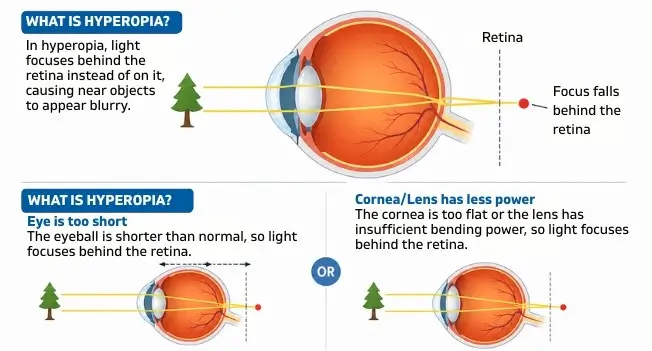
Your eye works a lot like a camera. Light enters through the front of the eye, gets bent (focused) by the cornea and lens, and lands on the retina at the back, producing a clear image.
In a healthy eye, this happens perfectly. But in a hyperopic (farsighted) eye, one of two things is slightly off:
N, and this is a common mix-up.
Hyperopia is a structural issue with how your eye is shaped. You can be born with it or develop it in early childhood.
Presbyopia is the blurry near vision that many people start experiencing after age 40. It happens because the lens inside your eye becomes stiffer with age and can't focus as well.
Both affect near vision, but they're different conditions with different causes. You can also have both at the same time.
Most cases of hyperopia are simply the result of the eye developing with a shape that does not quite match the ideal. It is predominantly a genetic condition; if one or both of your parents are farsighted, your chances of being hyperopic are meaningfully higher.
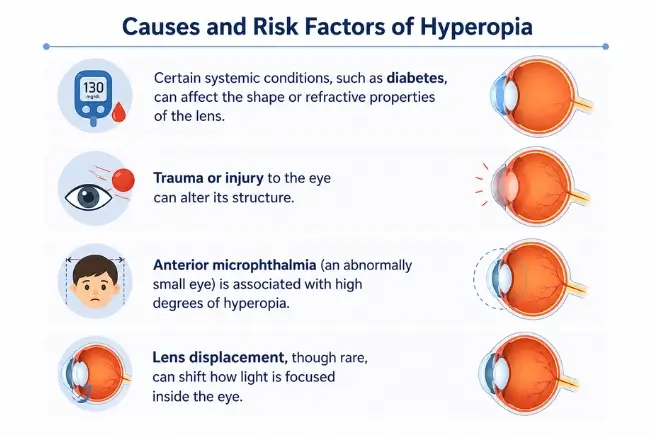
Beyond genetics and development, a few other factors can cause or contribute to hyperopia:
Here are the most common signs that you might be farsighted
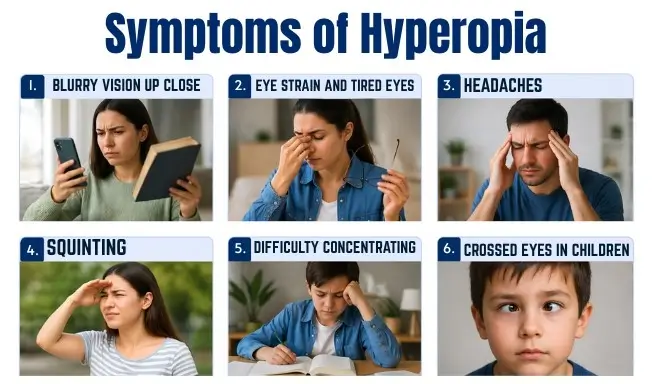
It becomes difficult to see things up close, like reading a book or using your phone. You may need to hold things farther away to see clearly.
Your eyes work extra hard to focus, which can make them feel tired, heavy, or uncomfortable after some time.
You may get headaches, especially after reading or using screens for a long time. This happens because your eyes are under stress.
You might find yourself squinting to see things clearly. This is your eyes’ way of trying to focus better.
When your eyes feel strained, it becomes hard to focus on reading or close work. Children may avoid studying or lose interest because of this.
In some cases, a child’s eyes may turn inward. This can be a sign of high hyperopia and should be checked by an eye doctor as soon as possible.
A simple eye chart test isn't always enough to detect hyperopia, especially if your eyes are adjusting and masking the problem. That’s why a complete eye check-up is important.
Here's what that typically involves:
The doctor places different lenses in front of your eyes and asks which one looks clearer. This helps find the correct power for your glasses.
Special eye drops are used to temporarily relax your eye muscles. This stops your eyes from overworking and shows the actual level of farsightedness, even the hidden part.
The doctor shines a light into your eyes and observes how it reflects back. This helps measure your eye power without requiring much of your response.
Tip for parents: Children should get a proper eye check-up before starting school. Basic school vision tests can miss hyperopia, so a detailed exam is always better.
You have several options depending on your age, lifestyle, and how severe your farsightedness is.
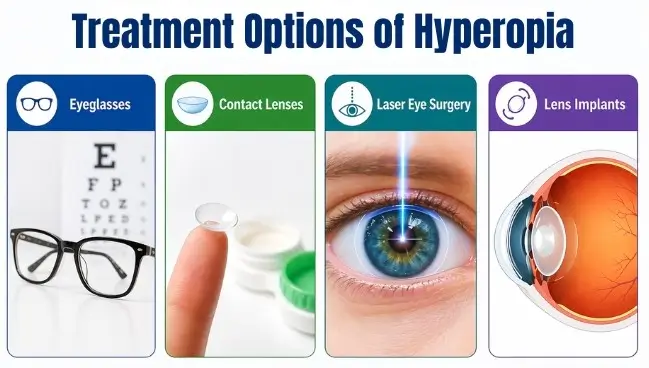
The simplest and most popular choice. Glasses with convex (plus-power) lenses add the focusing power your eye is missing. They're safe for all ages, easy to update when your prescription changes, and require zero maintenance beyond cleaning.
If you'd prefer not to wear glasses, contact lenses offer the same correction while sitting directly on your eye.
For adults (usually 18+) with a stable prescription, surgery can be a long-term fix.
Not everyone qualifies, so a pre-surgical evaluation is always required.
For high hyperopia or those who aren't candidates for laser surgery:
Even with the right correction, a few simple habits can make a big difference:
No, hyperopia and presbyopia are different. Hyperopia is a structural refractive error present from birth, while presbyopia is an age-related loss of focusing ability that usually begins after 40. A person can have both conditions at the same time.
Yes, in simple terms. Myopia causes distant objects to appear blurry, while hyperopia causes difficulty focusing on nearby objects. Both are refractive errors where the eye does not focus light properly.
Yes, most babies are naturally slightly farsighted at birth. This is normal and usually improves as the eyes grow. However, in some children, hyperopia persists and may require monitoring or correction.
No, screen time does not cause hyperopia. It is mainly determined by genetics and eye structure. However, excessive screen use can increase eye strain, headaches, and discomfort, especially if hyperopia is already present.
Yes, mild hyperopia may not cause noticeable blurry vision because the eye’s focusing muscles compensate. However, this can lead to hidden symptoms like eye strain, fatigue, and headaches, especially after reading or screen use.
Mild hyperopia mainly affects near vision. But in high hyperopia, both near and distant vision can become blurry because the eye cannot compensate effectively.
Children may not clearly express vision problems. Common signs include:
Yes, uncorrected hyperopia in children can increase the risk of amblyopia. The brain may start ignoring input from one eye, leading to reduced vision. Early detection and glasses can prevent this.
Children should have a comprehensive eye exam by age 3 to 4, or earlier if symptoms appear. Early screening helps detect hyperopia and other vision issues before they affect learning and development.
A plus (+) sign in your prescription indicates hyperopia. The number (e.g., +1.50 or +3.00) is measured in diopters and indicates the strength of the lenses needed. Higher numbers indicate greater farsightedness.
No, hyperopia cannot be cured with diet or eye exercises. While nutrients support overall eye health, they cannot change the eye’s structure, which is responsible for farsightedness.
It depends on the severity. Mild cases may require glasses only for reading, while moderate to high hyperopia usually needs full-time correction to reduce strain and improve visual comfort.
It is recommended to have an eye exam once a year or as advised by your doctor. Regular check-ups ensure your prescription stays accurate and help detect any changes early.
Yes, hyperopia can be corrected with laser vision correction procedures like LASIK or PRK in suitable candidates. These reshape the cornea to improve the focusing of light on the retina.
Copyright © 2025 | Save Sight Centre | All Rights Reserved.