
Age is often the first question people ask when considering laser eye surgery and understandably so. The good news is that the eligibility criteria for laser vision correction have evolved considerably, making it a viable option for a far wider age range than ever before.
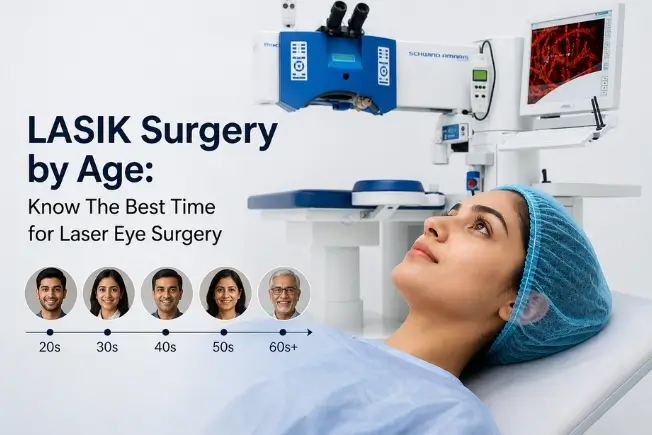
Laser-assisted in situ keratomileusis, more commonly known as LASIK (also called laser eye surgery) is the world's most widely performed refractive eye surgery. It involves reshaping the cornea using a precision laser, correcting the refractive errors that cause blurred vision:
✔ Myopia (short-sightedness),
✔ Hyperopia (long-sightedness), and
Its popularity stems from three qualities that few medical procedures can claim simultaneously: a strong safety record, highly predictable outcomes, and a relatively affordable cost compared to a lifetime of spectacles or contact lenses. For most patients, the procedure takes under 7-8 minutes per eye and delivers noticeable improvement in visual acuity within 24 hours.
But candidacy for laser vision correction is not a one-size-fits-all determination. The treating ophthalmologist evaluates each patient through a comprehensive eye examination. It includes assessing corneal thickness, pupil size, refractive stability, tear film quality, and overall ocular health before recommending the most appropriate procedure. Age is one important factor in that eligibility check, but it is rarely the deciding one.
The US Food and Drug Administration (FDA) has approved LASIK for patients aged 18 and above. This lower limit exists because the eyes continue to develop and grow until at least the late teenage years, meaning a prescription corrected too early may drift again as the eye matures. Most ophthalmologists additionally recommend waiting until the prescription has been stable for a minimum of 6 months before proceeding.
Key Eligibility Requirement
Stable eye power is the most critical factor for successful LASIK outcomes. A stable prescription for at least 6 consecutive months is typically required before surgery is considered.
There is no fixed maximum age for LASIK surgery. The decision mainly depends on the overall health of the eyes, whether the person has eye conditions like cataract or glaucoma, and the kind of vision improvement they want. With advances in LASIK technology and growing safety data over the years, more people from different age groups can now safely consider laser vision correction.
Here is a breakdown of general guidance for each stage of life, assuming the patient is otherwise in good health and free from contraindications.
STAGE 1
Under 18
NOT RECOMMENDED
The eyes are still developing. Vision correction will likely be temporary as the prescription shifts with natural growth. Exceptions exist for severe cases of amblyopia unresponsive to conventional treatment.
STAGE 2
18-40
IDEAL AGE RANGE FOR LASIK
The eyes are still developing. Vision correction will likely be temporary as the prescription shifts with natural growth. Exceptions exist for severe cases of amblyopia unresponsive to conventional treatment.
STAGE 3
40-60
PRESBYOPIA CONSIDERED; MONOVISION LASIK AVAILABLE
Reading vision begins to decline due to presbyopia. Monovision LASIK correcting each eye for a different distance. It offers practical freedom from both near and distance glasses.
STAGE 4
60 and Above
ELIGIBLE IF OCULAR HEALTH PERMITS
No hard upper age limit exists. Eligibility depends on the absence of cataract, glaucoma, or other organic causes of vision loss. A dilated eye examination guides the decision.
During childhood and adolescence, the eyeball itself is still growing. Performing refractive surgery before this growth is complete, is comparable to fitting a door frame before the walls are finished as the dimensions will change. Any correction made to an immature eye is likely to become partially or fully obsolete as the prescription shifts, leaving the patient back in spectacles within a few years.
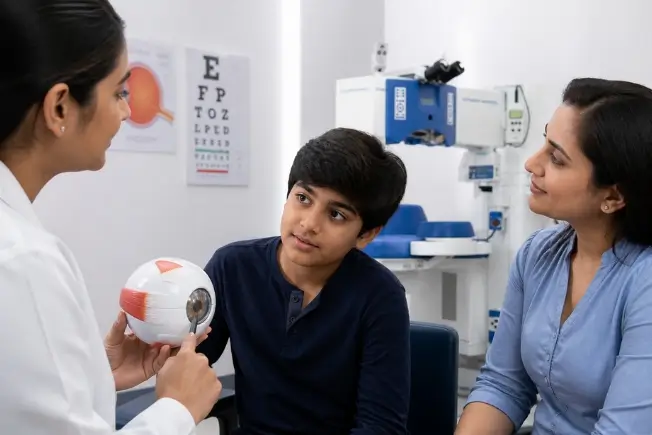
That said, LASIK has been used in selected paediatric cases where a child suffers from a severe refractive error contributing to amblyopia (commonly called "lazy eye"), and where glasses or contact lenses have been unable to provide adequate correction. In such cases, the potential benefit of preventing permanent vision loss may be greater than the risks of premature surgery.
Early adulthood is widely considered the optimal time for LASIK because:
✔ the prescription has usually stabilised,
✔ the cornea is healthy and sufficiently thick for safe reshaping, and
✔ the patient stands to enjoy more than two decades of clear and glasses-free vision before any age-related changes begin to intervene.
Mostly, candidates of this age group get excellent results and high satisfaction. Thus this is considered as the best and suitable age for LASIK surgery. The recovery is quick and almost every patient gets 6/6 vision.
Around the age of 40, many people start noticing difficulty in reading small text, using a phone, or seeing things clearly at close range. This common age-related condition is called presbyopia. It happens because the natural lens inside the eye gradually loses its flexibility, making it harder to focus on nearby objects.
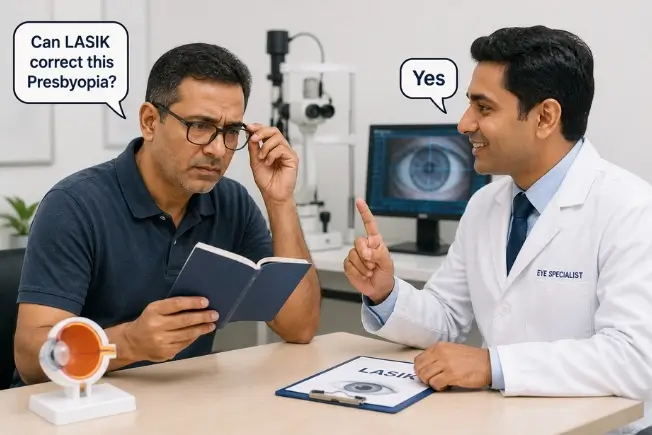
The good news is that presbyopia can also be managed with advanced LASIK treatment options. Today, eye specialists discuss different vision correction solutions that can help reduce dependence on both distance and reading glasses.
While some eye hospitals may suggest Monovision LASIK. Where one eye is corrected for distance and the other for near vision - our specialists generally do not prefer this approach for long-term use. Although some patients may adapt initially, it can sometimes affect depth perception and may not provide the most comfortable visual experience over time, especially for activities like night driving.
Tip for Patients Above 40 Years
Consult your eye specialist and discuss your needs and requirements with him. He would be the best person to guide you to the best treatment for your specs removal.
There is no fixed upper age limit for LASIK surgery. What matters most is the overall health of the eyes, not age alone. Many people in their 60s, 70s, and even older have successfully undergone laser vision correction and enjoyed greater freedom from glasses after years of depending on them.
The occurrence of certain eye conditions rises with age, and each must be assessed before LASIK is recommended. The most clinically relevant include:
Common after 60; if present and visually significant, cataract surgery is typically recommended first
Elevated intraocular pressure or optic nerve damage may preclude standard LASIK
Age-related macular degeneration affects central vision; its presence limits the expected benefit of LASIK
More prevalent in older adults; significant dry eye disease may need to be treated prior to surgery
Certain corneal conditions, which are more common in older adults, can affect healing after LASIK and may increase the risk of scratches or damage to the surface of the eye. That is why a detailed eye check-up before surgery is very important. Doctors carefully examine the cornea using advanced tests like corneal topography and slit-lamp evaluation to make sure the eyes are suitable for LASIK.
LASIK is not just for younger people. In older adults, it can also be used after cataract surgery to improve vision further. Sometimes, even after a cataract lens implant, a person may still have a small power left in the eye and may still need glasses. In such cases, LASIK can help fine-tune the vision and reduce dependence on glasses. This is known as a “laser enhancement” procedure and is becoming more common among senior patients.
KEY POINT FOR OLDER PATIENTS
Undergoing LASIK does not prevent cataracts from developing in the future. Patients should be advised that the natural aging of the lens is a separate biological process that laser reshaping of the cornea cannot halt or reverse.
The best next step is not a web search for the ideal surgery type. It is a consultation with a qualified ophthalmologist like Dr. Rajeev Jain, Dr. Shuchi Gupta, and Dr. Ankit Malhotra, who can perform a comprehensive dilated examination, map your corneal topography, assess your tear film, and discuss your visual lifestyle. They would help you understand which modern laser vision correction can genuinely offer you at your stage of life.
Do not let a number on a birthday cake make the decision for you.
Our LASIK specialists will evaluate your eyes and guide you on which laser eye surgery is a perfect fit for you.
Book NowCopyright © 2025 | Save Sight Centre | All Rights Reserved.